
All articlesdefect inspection
Structural Defect Inspection: Your Top Questions Answered
Inspectra AI Team November 16, 2026 8 min read
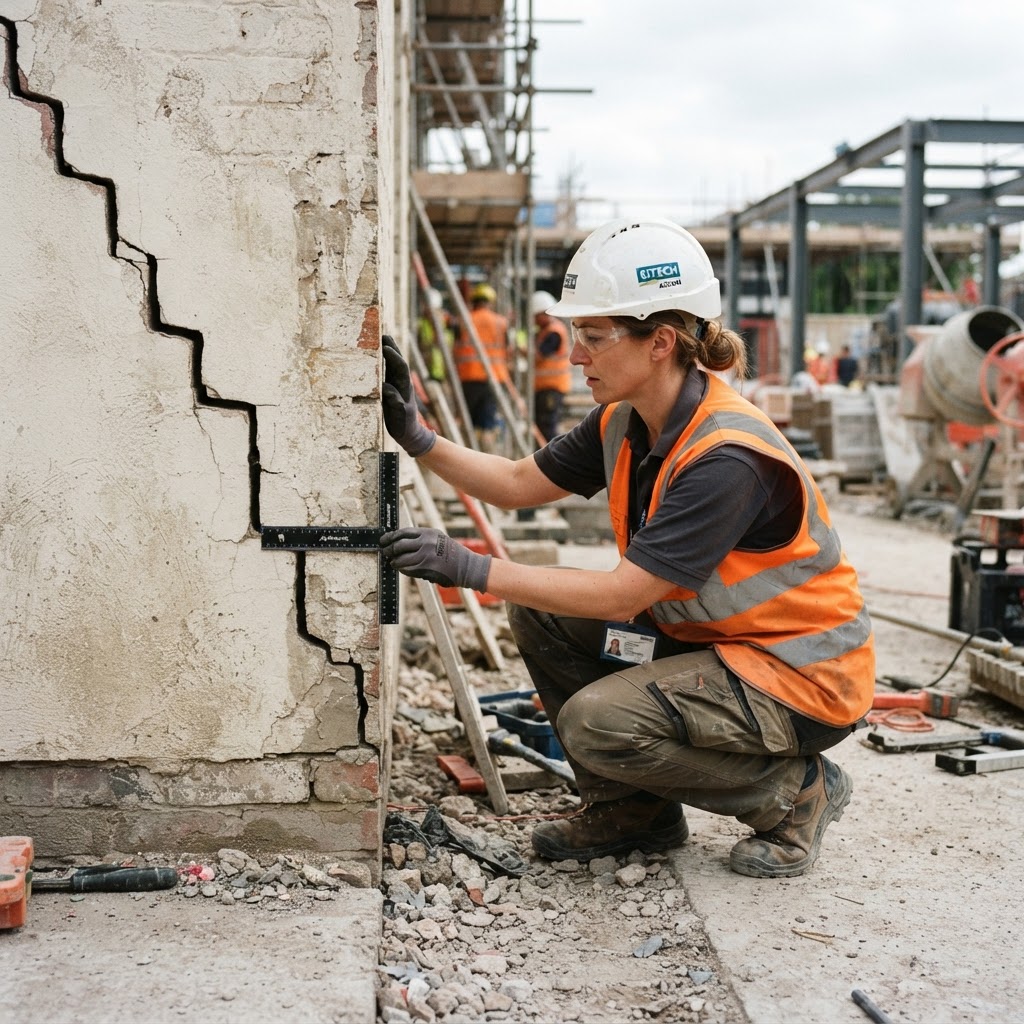
Structural defect inspections assess whether a building's load-bearing elements — foundations, beams, columns, slabs, and walls — are performing as designed. Done correctly, they produce legally defensible findings that protect owners, builders, and insurers across residential and commercial properties.
A structural defect inspection examines the components that transfer loads through a building to the ground. This is distinct from a general building inspection, which also covers non-structural elements like cladding finishes, tapware, and glazing.
| Element | What inspectors look for | |---|---| | Foundations and footings | Settlement, heave, cracking, moisture ingress | | Concrete slabs | Spalling, delamination, shrinkage cracks vs structural cracks | | Masonry walls | Stepped cracks, bulging, tie failure, mortar deterioration | | Structural steel | Section loss from corrosion, weld cracking, connection failures | | Timber framing | Rot, borer damage, inadequate bearer/joist sizing | | Columns and beams | Deflection beyond code limits, bearing failures |
In the UK, BS 5628 covers the structural use of masonry, while in the US, the International Building Code (IBC) and ASCE 7 set structural performance benchmarks inspectors reference when framing findings.
Not all cracks or deformations are equal. Most inspection frameworks use a severity scale to communicate risk clearly.
The Royal Institution of Chartered Surveyors (RICS) classifies masonry cracks on a 0–5 scale:
Under AS 4349.1-2007, inspectors are required to identify defects that are major (affecting structural integrity or habitability) separately from minor defects. Using imprecise language like "some cracking noted" without measurements and location references fails this standard.
Structural defect inspections are triggered by several scenarios:
Pre-purchase: Buyers commission inspections before settlement to identify defects that may affect value or safety. Under AS 4349.1, the inspector must report on major defects and safety hazards at minimum.
Defect liability period (DLP): In most Australian states, builders are liable for structural defects for 6–10 years post-completion (varies by state — e.g., 10 years in NSW under the Home Building Act 1989). An inspection close to DLP expiry protects owners from losing remedy rights.
Insurance claims: Insurers require structural defect documentation to assess causation — whether damage stems from a sudden insured event or pre-existing structural failure. Adjusters in the US, UK, and Australia rely on precise inspector findings to make coverage decisions.
Post-event assessments: After earthquakes, floods, or fires, structural inspections determine whether a building is safe to occupy. In Australia, councils may mandate these under the Building Act frameworks of each state.
Construction stage inspections: Frame stage and pre-slab inspections catch structural non-conformances before they are concealed.
The quality of a structural defect report determines whether it holds up in a dispute, insurance claim, or tribunal proceeding.
Regardless of jurisdiction, a defensible structural defect report should include:
Inspectra AI's platform structures field notes and photos into report sections that meet AS 4349.1 and equivalent UK/US reporting frameworks automatically — reducing the time inspectors spend formatting and increasing defensibility. Learn more at Inspectra AI.
"Cracking observed throughout" tells a reader nothing actionable. Structural findings require location, dimension, orientation (vertical, horizontal, diagonal, stepped), and an assessment of whether the crack is active or dormant.
A 0.3 mm plaster crack above a door frame is cosmetic. A 6 mm stepped crack in a load-bearing brick wall is not. Conflating the two either alarms clients unnecessarily or, worse, buries a critical finding in a list of minor issues.
Photographs without a scale object are routinely challenged in tribunal proceedings. A coin, ruler, or crack gauge must appear in structural defect photos.
Inspectors who fail to recommend a structural engineer where findings exceed their scope of practice create liability for themselves and potentially allow dangerous conditions to go unaddressed.
Field inspectors are increasingly using AI-assisted tools to convert voice notes, site photos, and field observations into structured, standards-referenced reports at speed. This matters because:
The human review step remains critical. AI-generated draft reports require inspector sign-off to confirm accuracy and professional accountability.
A general building inspection (as defined by AS 4349.1 in Australia) covers the whole property including non-structural elements like finishes, fixtures, and drainage. A structural defect inspection focuses specifically on load-bearing components — foundations, slabs, structural walls, beams, and columns — and applies engineering-referenced criteria to assess their condition.
For a standard residential property, expect 2–4 hours on site, plus 2–4 hours for report preparation. Complex commercial buildings or multi-storey strata properties may require a full day on site and several days of reporting. Using AI-assisted reporting tools can reduce the report writing phase by 50–70%.
In Australia, AS 4349.1 requires inspectors to hold relevant qualifications — typically a building inspector licence or, for more complex structural matters, a registered structural engineer. In the UK, Chartered Building Surveyors (MRICS/FRICS) commonly conduct structural surveys. In the US, InterNACHI-certified inspectors handle residential assessments, with licensed structural engineers engaged for commercial or complex findings.
Any defect that poses an immediate safety risk — active structural movement, imminent collapse risk, undermined foundations — must be communicated to the client before the written report is delivered. This obligation exists regardless of jurisdiction and is reflected in professional codes of conduct for inspectors and engineers alike.
Yes, provided it meets the documentation standards required by the relevant tribunal or court. In Australia, NCAT (NSW Civil and Administrative Tribunal) and equivalent state bodies regularly consider inspection reports as evidence in building defect disputes. Reports must be authored by a suitably qualified person, reference applicable standards, and present findings with sufficient precision to withstand cross-examination.
For residential properties, an inspection at the end of the defect liability period (typically 6–10 years post-construction in Australia) is strongly recommended. For commercial buildings, most facility managers schedule structural condition assessments every 5 years, or following any significant weather event, ground movement, or change of use. High-risk structures — bridges, retaining walls, heritage buildings — may require annual or biennial assessments.
Structural defect inspections require more precision, more rigour, and more careful documentation than general building inspections. Vague findings get challenged; well-evidenced, standards-referenced reports protect everyone involved — inspectors, owners, builders, and insurers.
If you're spending too much time formatting reports and not enough time on-site, start a free trial with Inspectra AI and see how AI-assisted reporting can lift your documentation quality without adding hours to your workflow.