
All articlesstrata inspection
Strata Defect Identification: Your Top Questions Answered
Inspectra AI Team November 15, 2026 9 min read
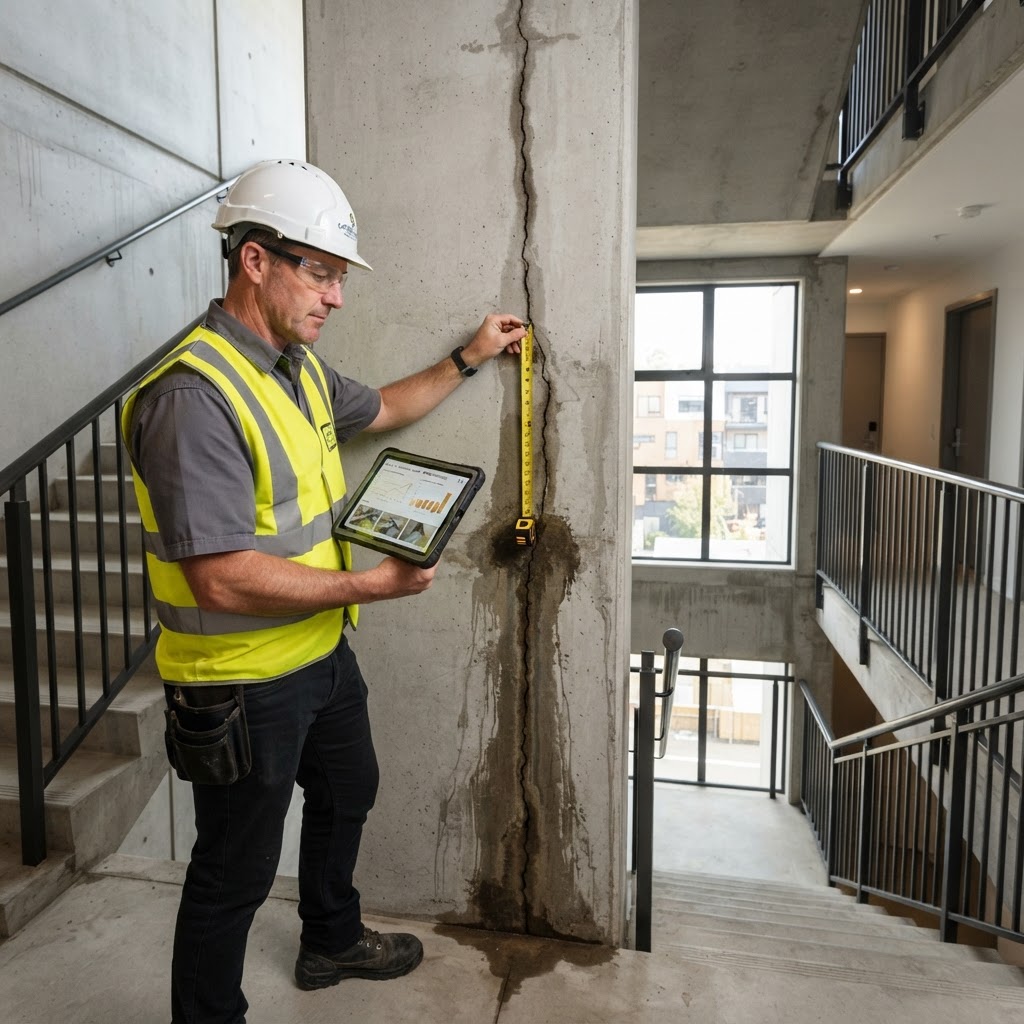
Strata defect identification is the process of locating, classifying, and documenting physical faults in a strata-titled building — including both common property and lot boundaries. Getting it right matters because defects left unrecorded can void warranty claims, trigger disputes between owners and developers, and create liability exposure for strata managers and inspectors alike.
A strata defect is any element of construction, materials, or workmanship that deviates from the building contract, the approved plans, or the relevant Australian Standard, British Standard, or local building code. The term covers everything from hairline cracks in render to failed waterproofing membranes and misaligned fire doors.
The distinction matters legally and practically:
| Category | Definition | Examples | |---|---|---| | Major defect | Causes the building or part of it to be uninhabitable, structurally unsafe, or affects a critical element | Structural cracking, roof membrane failure, water ingress into habitable spaces | | Minor defect | Does not affect habitability or structural integrity but represents non-compliant or substandard work | Surface cracking, paint defects, door alignment issues, grout gaps |
In New South Wales, the Design and Building Practitioners Act 2020 and the Home Building Act 1989 define major defects explicitly. The UK's Building Safety Act 2022 introduced a 30-year limitation period for claims relating to structural and fire safety defects in buildings over 11 metres. US standards vary by state, but InterNACHI's inspection SOP and ASTM E2018 provide widely accepted baselines for commercial strata-equivalent properties.
Field data from strata inspections consistently points to the same high-failure zones. Inspectors should prioritise these areas during any defect identification walkthrough.
Failed waterproofing is the single most common major defect in strata buildings. Balconies, wet areas (bathrooms and laundries), basement carparks, and roof decks are the highest-risk locations. AS 3740:2021 (Waterproofing of domestic wet areas) specifies minimum membrane upstands of 150 mm from finished floor level — a threshold frequently missed on site.
Cracks in render, delaminating cladding, failed sealant joints, and water ingress through windows and curtain wall systems are routine findings. Any crack exceeding 0.3 mm width in a structural element warrants further investigation under AS 3600 (concrete structures).
Fire door gaps, missing intumescent strips, penetrations in fire-rated walls, and non-compliant exit signage are defects that also constitute compliance failures. These must be escalated immediately, not simply logged for later.
Minor defects accumulate quickly in lobbies, corridors, stairwells, and car parks: uneven tiles, damaged handrails, failing light fittings, and defective garage doors. While individually minor, unresolved lists can represent significant remediation costs across a large strata scheme.
Documentation quality determines whether a defect can be successfully pursued. Weak documentation — blurry photos, vague descriptions, no location reference — gives developers and builders grounds to dispute or dismiss claims.
For each defect, capture:
A defect schedule is a tabulated list that links each defect to its location, classification, photographic evidence, and recommended action. Numbering defects sequentially and cross-referencing photos by filename makes the schedule usable in dispute resolution and adjudication.
Platforms like Inspectra AI can convert voice notes and field photos into structured defect schedules automatically, reducing the time between site walk and report delivery from days to hours.
The notification process has legal implications, particularly during the defect liability period.
Responsibility depends on what is defective and when.
The builder or developer holds primary rectification responsibility during the DLP. The owners corporation (Australia), residents' management company (UK), or homeowners association (US) is responsible for formally notifying and pursuing the claim.
Once statutory periods close, the strata corporation carries the cost of rectification unless a latent defect claim (a defect that was hidden and could not reasonably have been discovered) can be established. This is why early, thorough identification is so commercially important.
Defects in common property — the external facade, roof, structural slab, shared services — are the owners corporation's responsibility to manage. Defects within individual lots are generally the lot owner's responsibility unless caused by a common property failure (e.g., water ingress from a shared roof).
Traditional paper-based defect schedules are slow to produce, prone to transcription errors, and difficult to update. Modern inspection tools address these gaps.
AI inspection platforms ingest site photos, voice notes, and structured field observations, then generate formatted defect schedules and reports aligned to standard templates. This reduces reporting time, improves consistency, and creates audit trails that hold up under scrutiny.
With Inspectra AI, inspectors can photograph a defect, speak a description, and have a draft defect entry — with classification, location tag, and photo reference — ready for review immediately. Human approval remains in the loop before any report is finalised.
Cloud-based defect registers allow strata managers, inspectors, and legal representatives to track open and closed items across inspection cycles. This is particularly valuable for large schemes with hundreds of defects across multiple buildings.
A strata defect inspection is a targeted exercise focused on identifying construction faults, usually during or just before the end of the defect liability period. A strata inspection report (sometimes called a strata search) is a broader due diligence document prepared for prospective buyers that covers financial records, meeting minutes, insurance, and known defects. The two serve different purposes and are typically prepared by different practitioners.
A strata manager can coordinate and attend an inspection, but defect identification — particularly for major defects — should involve a licensed building inspector, structural engineer, or qualified building consultant. Strata managers generally do not carry the professional indemnity coverage or technical qualifications required to certify structural or waterproofing defects.
There is no fixed minimum, but each individual defect should have at least two photographs: one establishing the location context and one showing the defect in detail. For complex defects — such as large areas of water damage or structural cracking — annotated photo sequences with measurements provide significantly stronger documentation.
Options narrow considerably. Owners may pursue claims for latent defects (concealed defects undiscoverable at reasonable inspection) under tort law, but these are expensive and uncertain. Some states and territories have specific provisions — for example, Queensland's Queensland Building and Construction Commission Act 1991 allows claims up to 6 years and 6 months from practical completion for certain defects. Taking legal advice early is essential.
No. Most surface cracking in render, plaster, or non-structural masonry is minor and results from normal shrinkage or thermal movement. Structural concern arises when cracking exceeds 0.3 mm in structural concrete (AS 3600), when cracks are active or widening, when they appear in load-bearing elements, or when they are accompanied by differential settlement, water ingress, or displacement. A structural engineer should assess any crack where there is doubt.
Most strata schemes benefit from a formal condition inspection every 2–3 years for newer buildings and annually for buildings over 15 years old or those with known maintenance issues. Some Australian states, including NSW and Victoria, have mandated 10-year maintenance plans that require periodic condition assessments as a basis for the plan.
Strata defect identification is not a box-ticking exercise — it is a legally significant process with direct financial consequences for owners corporations, lot owners, and the professionals they engage. Getting the classification right, documenting thoroughly on site, and issuing formal notice within statutory timeframes are the three factors that determine whether defects get rectified at the developer's cost or the owners'.
If your current process relies on handwritten notes and unorganised photo folders, you are leaving money and legal protection on the table. Start a free trial with Inspectra AI and see how structured, AI-assisted defect documentation can protect your findings from the first site visit through to resolution.