
All articlessolar panel inspection
Solar Panel Warranty Inspection: What to Check and When
Inspectra AI Team November 24, 2026 10 min read
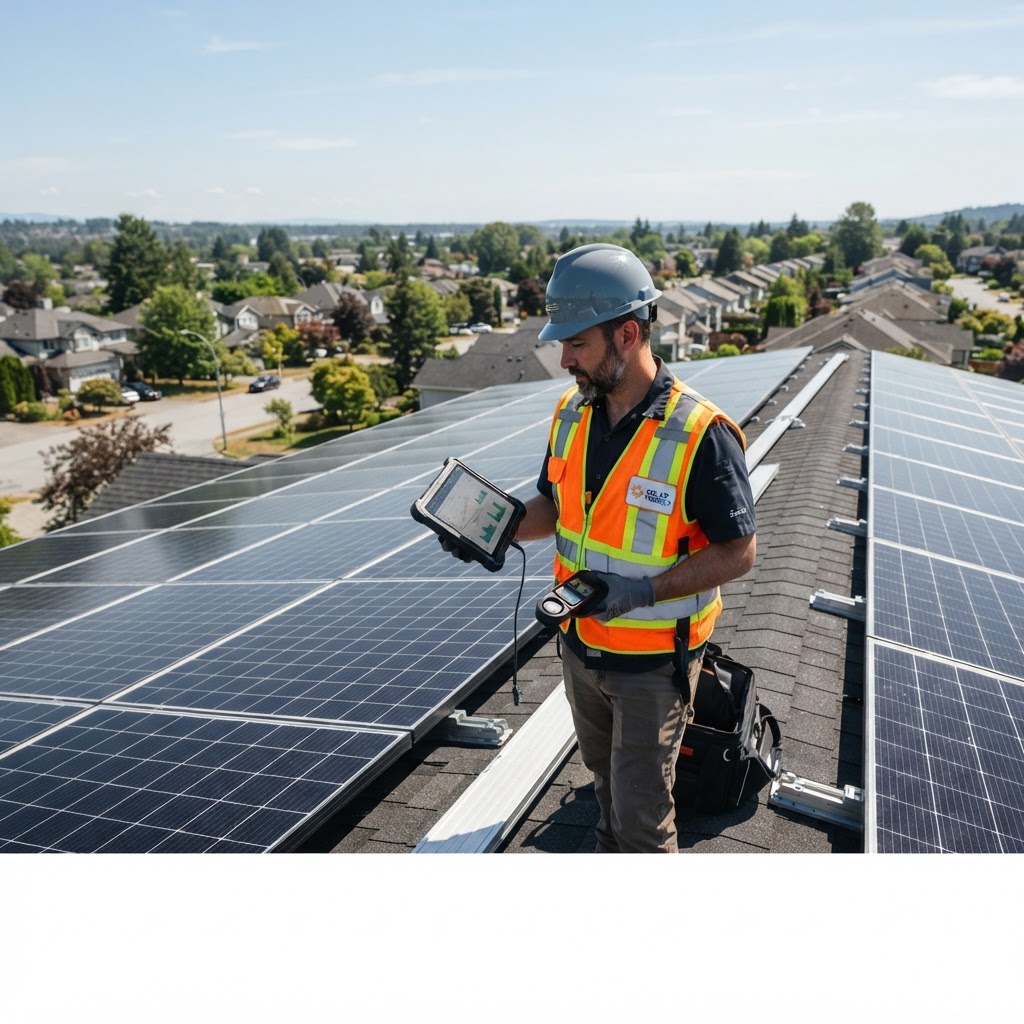
A solar panel warranty inspection is a formal assessment carried out to document system condition and support a manufacturer or installer warranty claim. Most residential solar warranties run 10–25 years for panels and 5–12 years for inverters, but claims are routinely rejected when defects aren't documented correctly or inspections aren't performed by qualified assessors. Getting the process right matters as much as identifying the fault.
Before scheduling an inspection, it helps to understand the two distinct warranty types that apply to most solar PV systems.
Product (materials and workmanship) warranty — Typically 10–15 years, this covers manufacturing defects, delamination, cell cracking, frame corrosion, and junction box failures. It does not cover damage from extreme weather, improper installation, or neglect.
Performance (power output) warranty — Usually 25 years, this guarantees the panel will produce at least a specified percentage of its rated output — commonly 80% at year 25. Degradation beyond the manufacturer's curve is a performance warranty event.
Installer workmanship warranty — Separate from the manufacturer's warranty, this covers installation errors such as incorrect wiring, inadequate mounting, or roof penetration failures. Duration varies by installer; 5 years is a common minimum in Australia under consumer guarantee law.
Knowing which warranty applies to the defect you've found determines which party you lodge the claim with and what evidence standard they'll apply.
There are four common triggers for a formal warranty inspection:
In Australia, the Australian Consumer Law (ACL) provides additional consumer guarantees that sit alongside manufacturer warranties, so documenting defects carefully matters even after formal warranty periods end.
Warranty inspectors need to be both technically competent and credentialled for the claim to be taken seriously by manufacturers.
| Region | Recognised qualification | |---|---| | Australia | CEC Accredited Installer; CEC Accredited Designer for large systems | | United States | NABCEP PV Installation Professional certification | | United Kingdom | MCS-certified installer; BPEC or City & Guilds 2399 for assessment |
For insurance-related warranty disputes, an independent electrical engineer's report may be required. Property managers and strata managers commissioning inspections on behalf of owners should confirm the inspector holds current accreditation before engaging them — an unaccredited report will likely be rejected by the manufacturer.
A systematic visual inspection is the starting point of every warranty assessment. The inspector works across the array methodically, checking:
All defects should be photographed with a consistent method: a wide-angle context shot, a mid-range shot showing the panel's position in the array, and a close-up with a scale reference or coin for size context. Time-stamp metadata must be intact.
Visual inspection alone is insufficient for most performance warranty claims. Electrical tests provide the quantitative evidence manufacturers require.
IV curve tracing measures the relationship between current and output voltage under field conditions, then compares it to the manufacturer's standard test condition (STC) ratings adjusted for measured irradiance and temperature. Significant deviation from the expected curve indicates cell degradation, bypass diode failure, or partial shading effects that point to defective panels.
Irradiance measurement must be conducted simultaneously using a calibrated pyranometer or irradiance meter to normalise the performance data. Without this, manufacturers can dismiss output shortfalls as measurement error.
Insulation resistance testing (Megger testing) checks whether moisture has penetrated the panel laminate or cabling, which causes gradual efficiency loss and creates a safety hazard.
EL imaging is the gold standard for detecting internal cell defects invisible to the naked eye. The technique passes a low-level direct current through the panel and captures the resulting infrared emission pattern. Cracked cells, inactive zones, and manufacturing defects appear as dark regions in the image.
EL imaging typically costs AU$150–$400 (US$100–$280 / £80–£220) per inspection as an add-on service. For a performance warranty claim involving high-value commercial arrays, the cost is almost always justified — manufacturers are far more likely to accept a claim backed by EL imaging than one supported by visual observations alone.
Thermal imaging identifies hotspots — localised areas of elevated temperature caused by cell mismatch, bypass diode failure, partial shading, or contamination. A hotspot running more than 20°C above ambient panel temperature is generally considered significant. AS/NZS 4777.1 (Australia/New Zealand grid connection standard) doesn't specify a thermal threshold for warranty, but most manufacturers reference IEC 61215 test methods when evaluating claims.
Thermal imaging should be conducted between 10am and 2pm local solar time, with irradiance above 700 W/m² and consistent cloud-free conditions, to produce reliable results.
Documentation quality is where most warranty inspections succeed or fail. A well-structured warranty inspection report should include:
Manufacturers have formal RMA (Return Merchandise Authorisation) processes that require specific data fields. Cross-referencing the report structure with the manufacturer's warranty claim form before writing the report reduces the risk of rejection on procedural grounds.
Platforms like Inspectra AI can help inspectors compile site photos, voice observations, and test data into a structured, professional report that meets documentation standards — reducing turnaround time and minimising errors that lead to claim rejection.
Understanding rejection patterns helps inspectors and property managers avoid them:
Costs vary by system size, test scope, and region.
| Inspection type | Australia (AU$) | United States (US$) | United Kingdom (£) | |---|---|---|---| | Visual only (residential) | $200–$400 | $150–$300 | £120–£250 | | Visual + IV curve tracing | $400–$800 | $300–$600 | £250–£500 | | Visual + thermal imaging | $450–$900 | $350–$650 | £280–£550 | | Comprehensive (visual + EL + thermal + IV) | $800–$1,800 | $600–$1,400 | £500–£1,100 | | Commercial array (per kW, varies) | $20–$50/kW | $15–$40/kW | £12–£35/kW |
For property managers and strata managers with multiple systems, bundled inspections across a building portfolio can reduce per-system costs by 20–30%.
A residential system inspection (6–13 kW) with visual checks and IV curve tracing typically takes 2–4 hours on site. Adding thermal imaging or EL imaging extends this to 4–6 hours. Report preparation adds another 1–3 hours depending on defect complexity.
Monitoring data is useful supporting evidence but is rarely sufficient on its own. Manufacturers require on-site measurements taken with calibrated instruments under known irradiance conditions. Screen-captured inverter data is easy to dispute without corroborating field measurements.
Snail trails are dark, winding discolourations on solar cells caused by silver-paste oxidation linked to micro-cracks, typically from manufacturing or handling. Most manufacturers cover snail trails under product warranty, particularly if they appear within the first 5–8 years. EL imaging confirms whether micro-cracks are present.
Yes. In strata-titled buildings, rooftop solar systems installed on common property are the strata corporation's responsibility. Warranty inspections should be commissioned by the owners corporation (Australia) or body corporate, and reports should reference the lot plan and common property boundaries. Some strata managers include solar inspection as part of their annual building maintenance program.
The claim shifts from the panel manufacturer to the installer's workmanship warranty. If the installer is no longer trading, Australian consumers may have recourse under the ACL's consumer guarantee provisions. In the US and UK, insurance-backed warranties (sometimes called deposit protection schemes for installers) may cover this scenario.
For high-value claims — where replacing panels would cost AU$3,000–$8,000 or more — EL imaging is almost always cost-effective. For small claims where the manufacturer's threshold for replacement is generous, a visual and IV curve inspection may be sufficient. Ask the inspector to advise based on the specific defect observed.
A solar panel warranty inspection is only as useful as the evidence it produces. Identifying a defect is the first step; documenting it in a format that satisfies a manufacturer's RMA process is what determines whether the claim succeeds. Use accredited inspectors, capture irradiance-corrected performance data, and structure your report around the manufacturer's claim requirements.
If you're managing inspections across multiple properties or need to turn field data into professional warranty documentation faster, start a free trial with Inspectra AI and see how structured reporting reduces rework and strengthens every claim you submit.