
All articlesconstruction inspection
Construction Site Inspection Sign-Off: A Step-by-Step Guide
Inspectra AI Team November 19, 2026 10 min read
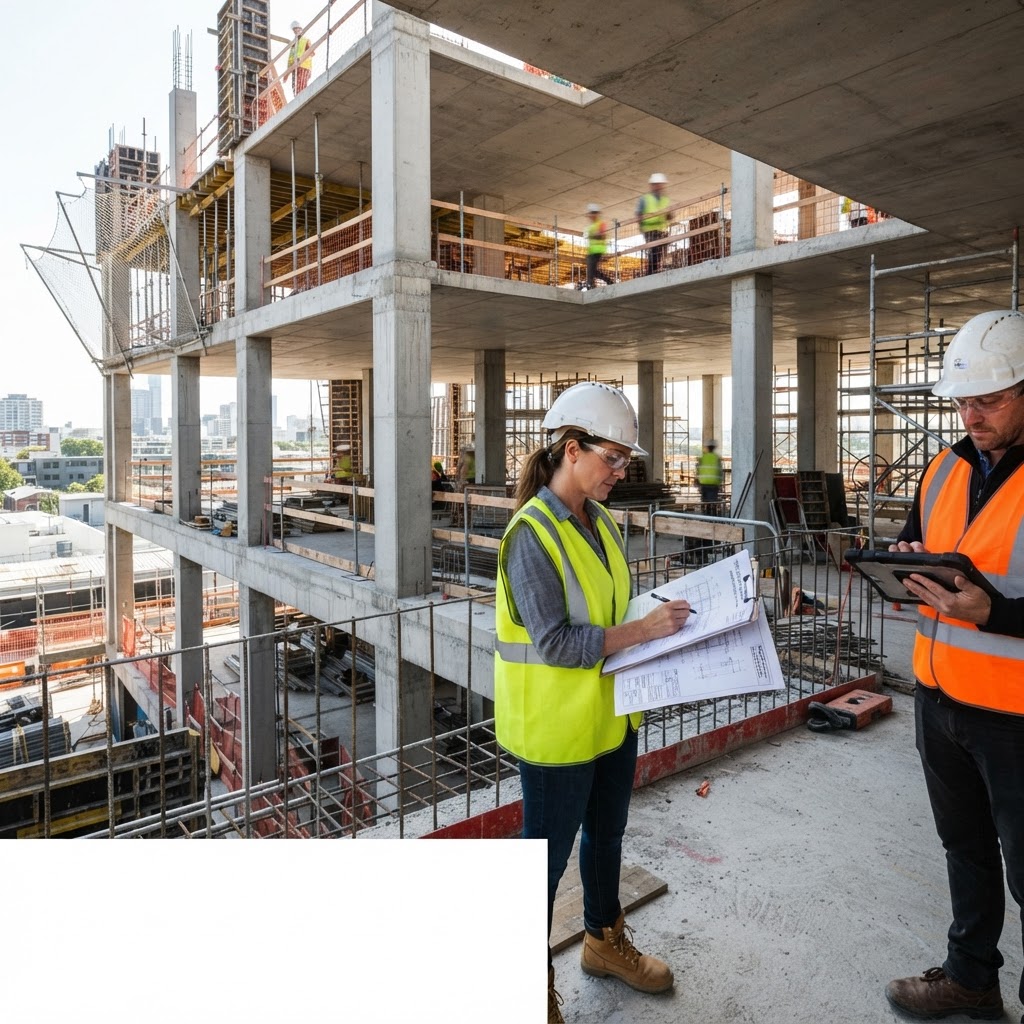
A construction site inspection sign-off is the formal process of verifying that completed work meets contract specifications, relevant standards, and safety requirements before the next stage begins or the project is handed over. Done correctly, it protects all parties — builder, client, certifier, and insurer. Done poorly, it creates liability that can take years and significant cost to resolve.
A sign-off inspection — sometimes called a hold point inspection or stage inspection — is a mandatory checkpoint where a qualified inspector, certifier, or superintendent reviews completed work before construction can legally continue. Hold points differ from witness points: at a hold point, work cannot proceed without written approval; at a witness point, the inspector is notified and may attend, but absence does not stop progress.
Most residential and commercial construction contracts specify hold points in the Inspection and Test Plan (ITP). Missing or skipping them without documented authority can void statutory warranties and insurance coverage.
Before mobilising for a sign-off inspection, verify what has triggered it.
Arrive only when the work is genuinely complete. Inspecting partially finished work wastes time and creates ambiguous records.
A sign-off inspection without reference documents is guesswork. Collect the following before site attendance:
| Document | Purpose | |---|---| | Approved construction drawings (latest revision) | Verify dimensions, materials, and configuration | | Specification schedules | Confirm product and workmanship standards | | Previous inspection reports for this stage | Identify any carry-over defects | | Material test certificates / conformance docs | Evidence that specified materials were used | | ITP with hold point matrix | Confirm scope of this inspection | | Relevant standard or code clause | The measurable benchmark for acceptance |
In the UK, retain copies of the Building Control approved plans. In the US, the AHJ-stamped permit drawings are your primary reference. In Australia, the DA (Development Approval) or CDC (Complying Development Certificate) documents set the envelope.
A consistent inspection sequence reduces the chance of missed items. The following framework applies to most stage inspections:
Before inspecting the work, assess site safety. Confirm:
Document any safety non-conformances separately — these are not defects, they are stop-work issues.
Measure against approved drawings. Common tolerances to apply:
In the UK, BS EN 13670 governs tolerances for concrete structures. For timber frames, BS 5268 applies.
Record every measurement with its location reference (grid line, drawing number, offset from datum). Photos without measurement context are frequently rejected in dispute resolution.
Verify that installed materials match the specification:
Identify defects that fall outside acceptable workmanship standards. Classify each finding:
Use consistent defect terminology — "crack", "delamination", "inadequate cover", "incorrect product" — rather than subjective language like "looks wrong".
Delayed documentation is a liability risk. Notes written hours or days after the inspection are vulnerable to challenge. Best practice:
PRJ001_20250612_B3_NCR04).Inspectra AI processes field photos, voice notes, and observations into structured inspection reports automatically, eliminating the transcription bottleneck that causes most sign-off delays.
At the conclusion of the inspection, one of three outcomes applies:
All work meets specification. Issue a dated sign-off certificate referencing:
Minor observations exist but do not prevent progress. Issue sign-off with attached observation list and a reinspection requirement for noted items before the next hold point.
Issue a formal NCR (Non-Conformance Report) that includes:
NCRs should be numbered sequentially per project and tracked in a register. In contract disputes, a complete NCR register is one of the most powerful pieces of evidence available to either party.
Sign-off is not complete until every NCR from the inspection has been closed. Close-out steps:
In Australia, records must be retained for a minimum of seven years under most state building acts; for structural elements, ten years is the safer standard. In the UK, the Building Safety Act 2022 requires "golden thread" documentation for higher-risk buildings, meaning all inspection records must be accessible digitally throughout the building's lifecycle.
| Failure | Consequence | Prevention | |---|---|---| | No dated signature on sign-off record | Record is inadmissible in dispute | Use tamper-evident digital signatures | | Inspection conducted without approved drawings | Cannot verify conformance | Mandatory pre-inspection document check | | Photos lack location reference | Cannot be mapped to defect location | Use grid references in every photo caption | | NCR closed without reinspection | Defect may persist undetected | Require physical sign-off for all structural NCRs | | Hold point missed or waived verbally | Statutory warranty may be void | All hold point waivers must be documented in writing |
This depends on jurisdiction and contract type. In Australia, sign-off at critical stages typically requires a licensed building certifier or the principal certifying authority (PCA). In the UK, a Building Control surveyor or approved inspector signs off work against Building Regulations. In the US, the AHJ inspector signs off at permit-required stages. The contract superintendent may also have sign-off authority for non-statutory hold points.
For internal quality hold points, yes — but this must be clearly distinguished from independent third-party sign-off. Statutory inspections require an independent qualified party. Self-certification without proper authority has been central to several high-profile building defect cases in Australia and the UK, leading to stricter licensing requirements.
Missing a mandatory hold point can have serious consequences: the building certifier may require the work to be opened up and exposed for retrospective inspection, at the contractor's cost. In some jurisdictions, the PCA must be notified and may issue a stop-work order. Insurance coverage for the relevant stage may also be jeopardised.
Typical durations range from 1–2 hours for a residential frame inspection to a full day for a large commercial slab or façade sign-off. Complexity, site size, and the number of outstanding NCRs from previous stages all affect duration. Build in time for documentation — at least 30–60 minutes for a residential inspection.
A sign-off inspection occurs during construction at defined hold points and is forward-looking — it determines whether work can proceed. A defect liability period (DLP) inspection occurs after practical completion and is retrospective — it identifies defects that have emerged post-handover. The DLP in most Australian contracts is 12 months; in the UK under JCT contracts, it is typically 12 months; under NEC contracts, the defect correction period is specified in the contract data.
Records should be stored in a project document management system (not personal email) with version control and access logs. For higher-risk buildings in the UK, the Building Safety Act 2022 requires a maintained "golden thread" of information. Recommended minimum retention periods are 7–10 years for structural stage records.
A construction site inspection sign-off is only as reliable as the process and documentation behind it. The six steps above — confirming the hold point trigger, gathering documents, conducting a structured physical inspection, recording findings in real time, issuing a formal outcome, and closing out NCRs — form a defensible, repeatable framework that holds up under contract scrutiny and regulatory review.
If your current process relies on handwritten notes, delayed photo uploads, or informal email sign-offs, the administrative burden alone is slowing your projects down and creating gaps in your records. Start a free trial with Inspectra AI and generate your first structured sign-off report directly from site — before you leave the building.