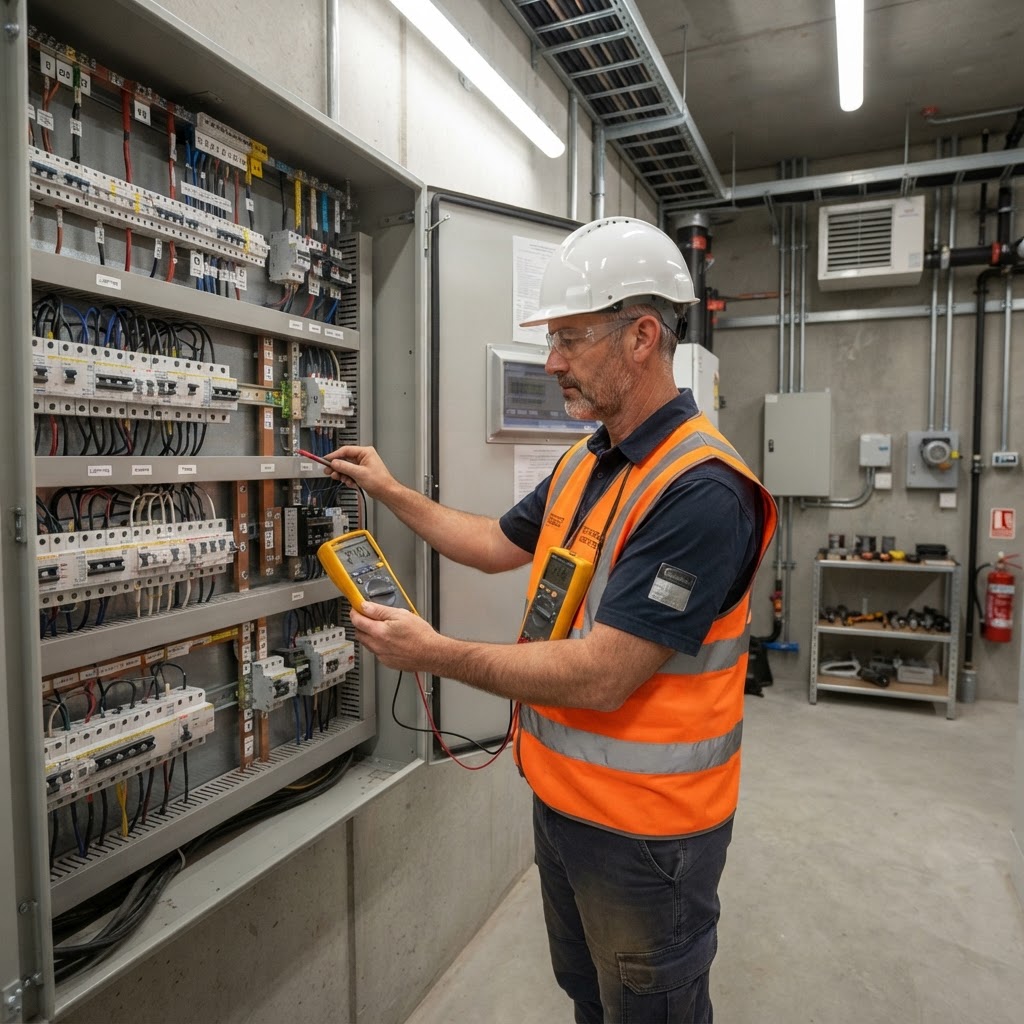
An electrical safety audit is a systematic review of a building's electrical installations, equipment, and documentation to verify compliance with relevant wiring standards and identify hazards before they cause injury or fire. For commercial buildings, audits should be conducted at least every five years — or after any significant fit-out, storm event, or change in occupancy. This checklist covers every major area inspectors need to assess.
Key takeaways
- Electrical safety audits in commercial buildings must reference the applicable wiring standard for your jurisdiction: AS/NZS 3000 (Australia/NZ), BS 7671 (UK), or NFPA 70 / NFPA 70E (US).
- Most regulatory bodies require a licensed or registered electrician — or a certified electrical inspector — to sign off on audit findings.
- Switchboard condition, earthing integrity, and RCD (residual current device) performance are the three highest-risk areas in most commercial audits.
- Documented test results (insulation resistance, earth loop impedance, RCD trip times) are legally required evidence in most jurisdictions.
- AI-assisted tools like Inspectra AI can cut report drafting time by up to 70% without removing the inspector from the compliance sign-off process.
Who should use this checklist
This checklist is written for:
- Licensed electrical inspectors conducting periodic compliance audits
- Facility managers and property managers preparing for a third-party audit
- Insurance adjusters assessing electrical risk for underwriting or claims
- Construction professionals completing practical completion inspections
- Strata managers overseeing common-area electrical infrastructure
It is not a substitute for jurisdiction-specific certification requirements. Always confirm which standard applies before commencing an audit.
Pre-audit preparation
Before arriving on site, gather the following documentation:
| Document | Why it matters |
|---|---|
| Previous electrical inspection or test certificate | Establishes baseline condition and outstanding defects |
| As-built wiring diagrams / single-line diagrams | Required to verify circuit labelling and load distribution |
| Switchboard schedules | Used to confirm every circuit is accounted for |
| RCD and circuit breaker test logs | Reveals whether routine testing has been performed |
| Maintenance records for fixed plant | Flags equipment approaching end-of-life |
| Occupancy permit or certificate of occupancy | Confirms the approved use hasn't changed |
Confirm with the building owner or facilities manager whether any circuits will need to be de-energised during the audit, and arrange a suitable time to minimise business disruption.
Section 1: Switchboard and distribution boards
The main switchboard (MSB) and any sub-distribution boards are the nerve centre of a commercial electrical installation. Defects here can cascade to every circuit in the building.
Visual inspection checklist
- [ ] Switchboard enclosure is IP-rated appropriately for its location (e.g. IP54 in wet areas per AS/NZS 3000 clause 2.3)
- [ ] All protective covers and blanking plates are in place — no exposed live parts
- [ ] Cabinet is clean and free of dust, moisture ingress, or pest activity
- [ ] Busbars show no signs of overheating (discolouration, melting, carbon deposits)
- [ ] Circuit breakers and fuses are correctly rated for the cables they protect
- [ ] Every circuit is clearly and accurately labelled
- [ ] No unauthorised modifications or added circuits since last inspection
- [ ] Adequate working clearance in front of the board (minimum 600 mm in Australia, 900 mm under NFPA 70 for 0–150V to ground)
Testing requirements
- [ ] Insulation resistance test on all circuits (minimum 1 MΩ per AS/NZS 3017; 1 MΩ per BS 7671 Regulation 643.3)
- [ ] Earth loop impedance measured at the MSB
- [ ] Prospective short-circuit current (PSCC) verified against breaker interrupt ratings
- [ ] Thermal imaging scan of all busbars and connections (recommended for boards over 10 years old)
Section 2: RCDs and residual current devices
RCDs (called GFCIs — ground fault circuit interrupters — in the US) are the primary defence against electrocution. Under AS/NZS 3000:2018, all socket outlets in commercial premises must be RCD-protected. BS 7671:2018 (Amendment 2, 2022) extends similar requirements across most commercial circuits.
RCD audit checklist
- [ ] All socket outlet circuits serving areas accessible to the public or non-electricians are RCD-protected
- [ ] RCDs are tested using a calibrated RCD tester (not just the test button)
- [ ] Trip time does not exceed 300 ms at rated tripping current (AS/NZS 3017); Type S (selective) RCDs must trip within 500 ms
- [ ] 10 mA RCDs are installed in high-risk locations (bathrooms, kitchens, outdoor circuits) where required by local regulations
- [ ] Test results are recorded with date, tester ID, and instrument calibration reference
- [ ] RCD test button functionality confirmed on every device
Section 3: Wiring and cables
Visual and physical inspection
- [ ] All cables are supported at correct intervals (AS/NZS 3000 Table 3.2 for Australia; IET On-Site Guide Table 6A for UK)
- [ ] No cables routed through sharp edges, conduit ends, or structural penetrations without appropriate protection
- [ ] Cable insulation is intact — no cracking, brittleness, or rodent damage visible
- [ ] Cables in ceiling spaces, risers, and plant rooms are correctly fire-rated where required
- [ ] Flexible cords are not used as permanent wiring
- [ ] All junction boxes are accessible, enclosed, and labelled
- [ ] Wiring in wet areas uses appropriate cable type and entry seals
Older installations — specific risk factors
Buildings constructed before 1980 may contain:
- Aluminium wiring — requires specialist connectors and regular joint inspection due to oxidation creep
- Rubber-insulated cables — insulation becomes brittle with age; replacement is often warranted after 30–40 years
- Knob-and-tube wiring (common in older US buildings) — incompatible with modern load demands and insulation
Document any of the above explicitly in your report with a recommended action and timeframe.
Section 4: Earthing and bonding
Earthing (grounding in US terminology) provides the fault current return path that allows protective devices to operate. Bonding ensures that all metallic parts remain at the same potential, preventing shock from touch voltage.
Earthing checklist
- [ ] Main earthing conductor is correctly sized per AS/NZS 3000 Table 5.1 / BS 7671 Table 54.7
- [ ] Earth electrode resistance measured and within acceptable limits (typically ≤ 1 Ω for TT systems; verify against local network requirements)
- [ ] Main protective bonding conductors connected to: water service pipes, gas service pipes, structural steel, HVAC ductwork
- [ ] Supplementary bonding in bathrooms and wet areas verified
- [ ] MEN (multiple earthed neutral) link confirmed in place and secure at MSB (Australia-specific)
- [ ] Earth continuity confirmed at all socket outlets using a socket tester or loop tester
Section 5: Lighting systems
- [ ] Emergency and exit lighting tested for minimum 90-minute battery backup (AS 2293.1 in Australia; BS 5266-1 in UK; NFPA 101 in US)
- [ ] Exit signs are illuminated, unobstructed, and correctly oriented
- [ ] All luminaires are appropriate for their environment (IP rating in wet or dusty areas)
- [ ] No exposed lamp holders or missing diffusers
- [ ] Lighting circuits are correctly load-balanced across phases in three-phase installations
- [ ] Any LED retrofit drivers are thermally managed and rated for the enclosure
Section 6: Fixed plant and equipment
This section covers HVAC units, pumps, compressors, and other fixed electrical plant.
- [ ] Each item of plant has a dedicated isolator within sight of the equipment (AS/NZS 3000 clause 4.5; NFPA 70 Article 430)
- [ ] Motor starter overloads are correctly rated
- [ ] Thermal overload protection is functional and set to motor nameplate full-load current
- [ ] All plant is earthed and bonding verified
- [ ] Flexible connections to plant use appropriate flexible conduit or cord
- [ ] Vibration has not loosened electrical connections (check terminal tightness on compressors, pumps)
Section 7: Hazardous areas and special locations
Some commercial premises contain areas where flammable vapours, dust, or extreme conditions create additional electrical risk.
- [ ] Any area classified as Zone 0, 1, or 2 (IEC 60079) or Class I Division 1/2 (NEC) is identified and documented
- [ ] Electrical equipment in classified areas is certified for that classification (e.g. Ex d, Ex e, Ex n)
- [ ] Certificates of conformity for Ex equipment are available on site
- [ ] Kitchen areas: deep fryer extraction canopies have appropriate interlocks with cooking equipment
- [ ] EV charging infrastructure (if present): installation complies with AS/NZS 3000 and AS/NZS 61851 (AU) or BS 7671 Appendix 17 (UK)
Section 8: Documentation and compliance records
A physical audit is only half the job. Documentation failures are among the most common reasons audits result in non-compliance notices.
- [ ] Electrical installation certificate (EIC) or certificate of compliance is on file for all work done since last inspection
- [ ] Test and inspection records are retained for minimum 5 years (AS/NZS 3017; BS 7671 Regulation 653)
- [ ] Any defects from previous audits have been formally closed out with supporting documentation
- [ ] Electrical safety management plan is current and accessible to facilities staff
- [ ] Emergency contacts for the responsible person (RP) and appointed electrician are posted at the MSB
Defect classification: what to document and how
Not all defects carry the same urgency. Use a consistent classification system in your report:
| Classification | Definition | Recommended action |
|---|---|---|
| C1 — Danger present | Risk of injury or fire without immediate action | Isolate and rectify before re-energising |
| C2 — Potentially dangerous | May become dangerous; action required | Rectify within 28 days |
| C3 — Improvement recommended | Not dangerous but does not meet current standards | Address at next planned maintenance |
| FI — Further investigation | Condition cannot be fully assessed during audit | Commission specialist investigation |
This classification framework aligns with BS 7671 and is widely adopted in Australian and US practice as well.
How AI tools are changing electrical audit reporting
Field inspectors using Inspectra AI can photograph switchboards, cable runs, and plant items on site, add voice notes describing defect classification and location, and have a structured draft report — including defect tables, photo references, and compliance citations — ready for review before they leave the building. The licensed inspector still reviews, amends, and signs off every finding; the AI handles the drafting overhead.
For high-volume auditors managing multiple commercial sites, this means more time on the tools and less time at the keyboard.
Frequently Asked Questions
How often should a commercial building have an electrical safety audit?
Most Australian states recommend every five years for commercial premises under AS/NZS 3017, though high-risk occupancies (hospitals, aged care, schools) may require more frequent inspection. In the UK, BS 7671 recommends a maximum interval of five years for commercial premises. US requirements vary by state and insurer, but NFPA 70B recommends annual thermographic inspections for critical distribution equipment.
What qualifications does an electrical auditor need?
In Australia, a licensed electrical inspector or electrician with inspection certification is required. In the UK, audits must be carried out by a competent person under BS 7671 — typically a registered electrician with an ECS card and inspection and testing qualification (City & Guilds 2391 or equivalent). In the US, NFPA 70E audits are typically conducted by a Qualified Electrical Worker (QEW) as defined by OSHA 29 CFR 1910.333.
What is the difference between an electrical audit and a test and inspection?
A test and inspection (T&I) focuses on measuring specific electrical parameters — insulation resistance, earth loop impedance, RCD trip times — against wiring standard thresholds. A safety audit is broader: it includes T&I but also covers documentation, management systems, equipment condition, labelling, and compliance with occupancy-specific regulations. Many commercial engagements require both.
What happens if an auditor finds a C1 (danger present) defect?
A C1 defect requires immediate action. The auditor should notify the building owner or responsible person in writing immediately and, in most jurisdictions, the affected circuit or equipment must be isolated before the premises can continue operating normally. The auditor may also have a statutory duty to notify the electrical safety regulator depending on the jurisdiction.
Can I use photos taken on a smartphone as audit evidence?
Yes, provided photos are geotagged, timestamped, and clearly referenced to the defect or item in the report. Many insurers and certifying bodies now accept digital photo evidence, but the resolution must be sufficient to clearly show the defect. Tools that automatically link photos to report line items (as Inspectra AI does) reduce the risk of evidence getting lost or misattributed.
How long does a commercial electrical safety audit take?
For a single-tenancy commercial building up to 500 m², expect four to eight hours including documentation review and testing. Larger or multi-tenancy buildings scale roughly with the number of distribution boards and circuits. Report preparation traditionally adds two to four hours; AI-assisted drafting can reduce that to under one hour for experienced inspectors.
Bottom line
A thorough electrical safety audit covers eight core areas: switchboards, RCDs, wiring, earthing, lighting, fixed plant, hazardous locations, and documentation. Using a consistent defect classification system — C1 through FI — ensures every finding is actioned at the right priority level and creates a defensible audit trail.
If you're managing a high volume of commercial audits, start a free trial with Inspectra AI to see how AI-assisted reporting can cut your post-inspection admin without compromising the rigour your clients and regulators expect.