
All articlesfacility inspection
Facility Inspection Reporting Errors That Void Your Findings
Inspectra AI Team November 11, 2026 10 min read
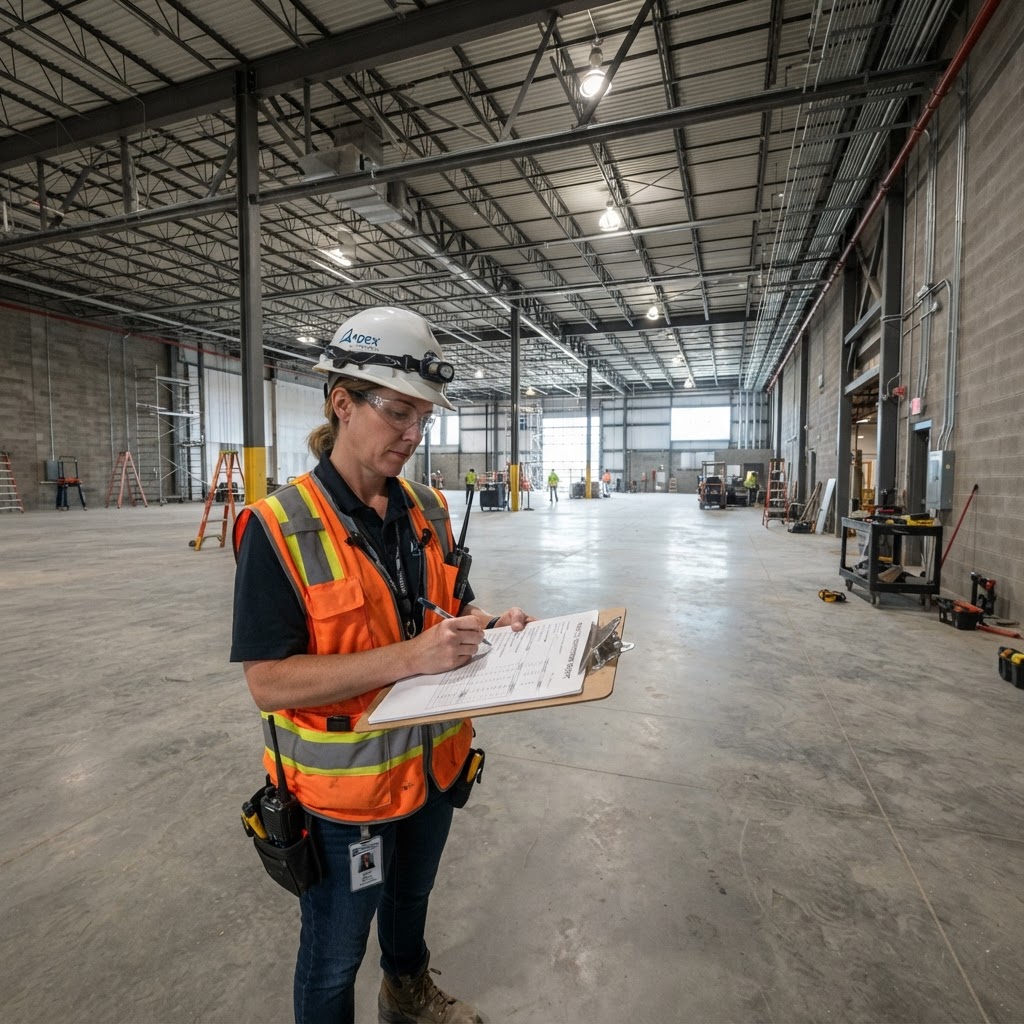
Poor documentation is the single most common reason facility inspection findings get challenged, dismissed, or legally voided. Even a thorough on-site inspection can be rendered worthless if the resulting report contains vague descriptions, missing evidence, or non-compliant formatting. This article identifies the reporting errors that matter most — and how to eliminate them.
An inspection report is not simply a record of what you saw — it is a legal, technical, and commercial document. For insurance adjusters, a report without measurable data points may be insufficient to support a claim. For strata managers in Australia, a report that fails to reference the strata scheme's maintenance obligations under the Strata Schemes Management Act 2015 (NSW) may carry no enforcement weight. For UK property managers, findings not aligned with RICS condition ratings can be challenged during dispute resolution.
The errors below appear across all sectors and geographies. Each one is avoidable.
Terms like "deterioration observed," "minor damage," or "some wear noted" mean different things to different readers. A contractor may interpret "minor cracking" as hairline fracture; a structural engineer may read it as a 3mm displacement. Without measurable descriptors, your findings cannot be acted upon or verified.
Photographs submitted without metadata — no timestamp, no geotag, no reference scale — are routinely rejected in insurance claims and legal proceedings. A photo showing a cracked slab means little if it cannot be tied to a specific location, date, and inspector.
| Requirement | Why it matters | |---|---| | Timestamp embedded in EXIF data | Proves inspection occurred on the stated date | | GPS coordinates or site reference | Locates the defect precisely within the facility | | Scale reference (ruler or object) | Enables third-party measurement verification | | Context shot + close-up pair | Shows location and detail simultaneously | | Inspector ID or watermark | Establishes chain of custody |
In Australian building inspections under AS 4349.1-2007, photographic evidence should be sufficient for a third party to identify the element and its condition without visiting the site. That is a practical benchmark worth adopting universally.
Every professional inspection report must clearly state what was inspected, what was not, and why. This is not boilerplate — it is a liability boundary. If you did not access the roof void, the sub-floor, or the mechanical plant room, that must be explicitly documented.
Failure to include scope limitations is one of the most exploited weaknesses in disputed reports. A property manager or insurer can argue that an omitted area contained the source defect, and without documented limitations, you have no defence.
Facility inspections are rarely one-off events. Strata properties, commercial buildings, and industrial facilities are inspected periodically — often annually or quarterly. When terminology changes between report cycles, tracking defect progression becomes impossible.
If a 2022 report describes a roof element as "membrane flashing" and the 2024 report calls it "upstand sealant," a facilities manager cannot determine whether these are the same element, the same defect, or a new issue. This inconsistency can delay maintenance decisions and create compliance gaps.
Inspectra AI supports element-level tracking across inspection cycles, automatically cross-referencing current findings against historical entries.
An observation is what you directly perceive. An inference is your interpretation of its cause or significance. Conflating the two is a reporting error that undermines credibility and can expose you to negligence claims.
Incorrect: "Water damage caused by blocked gutters."
Correct: "Staining to internal ceiling consistent with water ingress. Gutters on the adjacent elevation observed to be blocked with debris. Recommend further investigation to confirm source."
The first statement asserts causation without proof. The second documents evidence and draws a qualified inference. The distinction matters in insurance claims, where cause of damage determines coverage, and in legal disputes, where overclaiming is used to discredit the entire report.
A report that lists twenty defects without prioritising them forces the recipient to triage without expertise. This leads to low-priority items being addressed first because they are cheaper, while safety-critical defects wait.
In commercial facility management, this can constitute a duty of care failure. Under UK health and safety legislation (the Workplace (Health, Safety and Welfare) Regulations 1992), facility managers have a legal obligation to address hazards in order of risk. An inspection report that does not support that obligation may be considered inadequate.
Every defect entry should carry a priority rating, a recommended remediation action, and a responsible party where known.
A facility inspection report without citations is an opinion. A report with citations is professional evidence. When your findings reference specific clauses — AS 1851-2012 for fire protection maintenance, NFPA 80 for fire door inspections, or BS 9999 for fire safety in buildings — they carry weight that uncited observations simply do not.
This is especially important for insurance adjusters and construction professionals preparing defect liability claims. Courts and arbitrators treat standards-referenced findings as more reliable than general assessments.
| Context | Relevant standard | |---|---| | Australian building inspection | AS 4349.1-2007 | | US commercial property inspection | ASTM E2018-15 | | UK property condition | RICS Home Survey Standard 2021 | | Fire system maintenance (AU) | AS 1851-2012 | | Fire door inspection (US) | NFPA 80 | | Structural assessment (UK) | BS EN 1990 (Eurocode 0) |
Field-generated reports — particularly those produced under time pressure — frequently contain factual errors, transposed measurements, or misidentified elements. Distributing an unchecked report to a client, insurer, or regulator and then issuing a correction is damaging to professional credibility and can create conflicting document versions in a legal record.
All facility inspection reports should pass through a minimum two-stage review:
This is exactly the workflow Inspectra AI is built around — AI-assisted drafting followed by structured human approval before any report is released.
A common but underappreciated error is omitting elements that were inspected and found to be in satisfactory condition. If your report only lists defects, the recipient cannot determine what was actually inspected. This creates liability: if a component fails shortly after an inspection that did not mention it, your silence looks like an omission rather than a clean finding.
Every inspection report should include a complete element schedule with a condition status for each item — including those rated satisfactory. This is standard practice under RICS guidance and is increasingly expected by Australian strata managers and commercial property insurers.
Reports that are edited after distribution — even for legitimate corrections — must carry a clear version history: original issue date, amendment date, nature of amendment, and authorising inspector. Without this, edited reports are vulnerable to allegations of post-hoc alteration.
This matters most in insurance reinstatement claims and strata dispute proceedings, where the sequence of documentation is often as important as the content.
A legally defensible report is dated, geolocated, supported by calibrated photographic evidence, references applicable standards, clearly distinguishes observations from inferences, and carries a documented review trail. Vague language and missing scope statements are the most common weaknesses exploited in disputes.
Descriptions should be measurable and reproducible by a third party. Include dimensions, affected area, location relative to fixed reference points, and a condition rating aligned to a recognised framework (e.g. AS 4349.1 significance levels or RICS condition ratings 1–3).
For inspections conducted in Australia under professional obligation — including pre-purchase, strata, and commercial property inspections — referencing AS 4349.1-2007 (or the relevant specialist standard) is considered best practice and is expected by courts, insurers, and professional bodies. It is not always legally mandatory but is strongly advisable.
At a minimum, review terminology and element classification against the previous report in the series before each new inspection. For facilities inspected more than twice annually, a formal terminology register should be maintained and updated after each cycle.
Yes, but amendments must be clearly versioned — including original issue date, amendment date, a description of what changed, and the authorising inspector's details. Undocumented amendments to distributed reports are a serious professional and legal risk.
As a baseline, each defect entry should have at minimum one context photograph (showing location) and one close-up photograph (showing detail). Both should carry embedded timestamps and GPS data, or be manually referenced to a dated site plan. A scale reference should be included in close-up shots wherever practical.
The gap between a thorough inspection and a valuable inspection report comes down to documentation discipline. Vague language, missing evidence, absent scope statements, and uncited standards are not minor oversights — they are the specific weaknesses that get reports dismissed, claims rejected, and professionals exposed to liability.
If your current reporting workflow relies on freeform field notes, you are likely introducing several of these errors on every job. Structured templates, digital evidence capture, and a mandatory review step before distribution are the three changes with the highest impact.
If you want to see what a defensible, standards-referenced facility inspection report looks like in practice, start a free trial with Inspectra AI and run your next inspection through a structured workflow built for professional-grade output.