
All articlespest inspection
Pest Inspection Report Writing: Mistakes That Undermine Your Findings
Inspectra AI Team October 11, 2026 10 min read
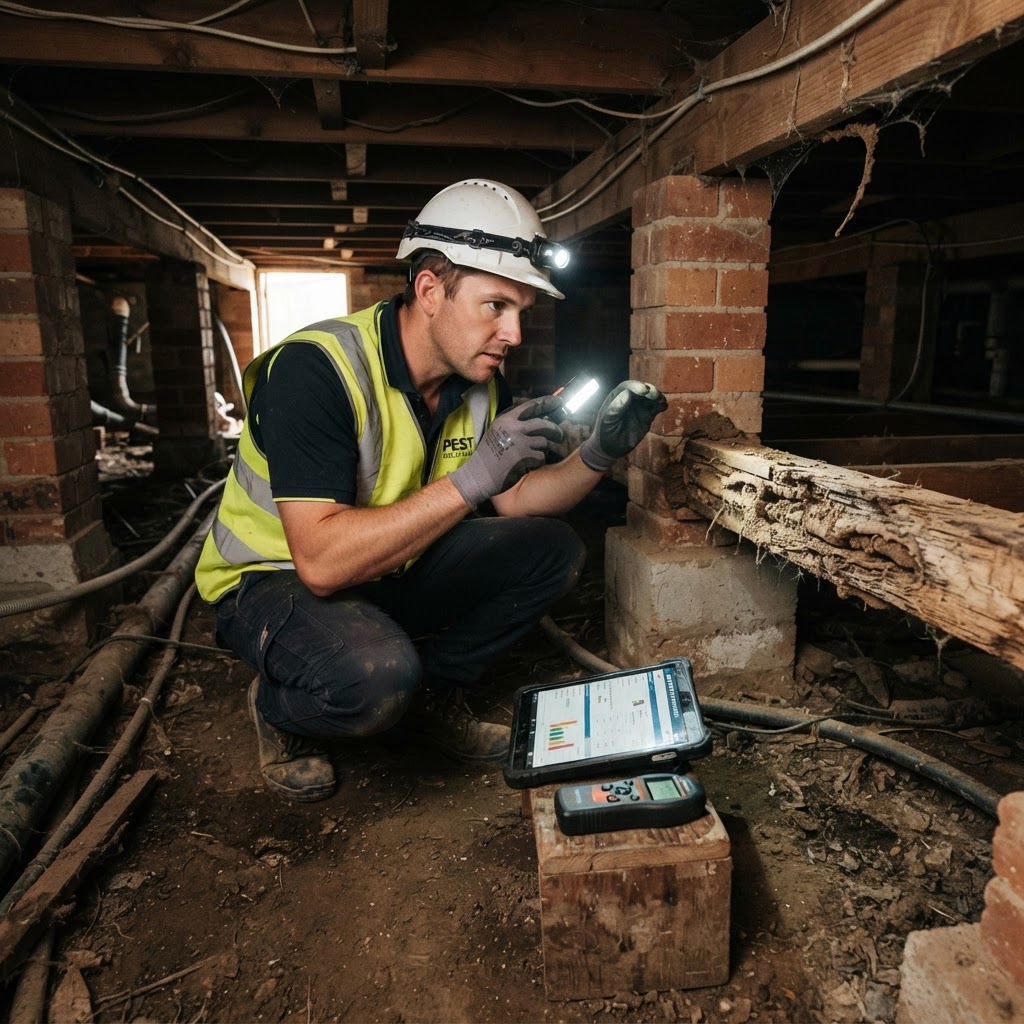
A poorly written pest inspection report can be just as damaging as a missed infestation. Even when an inspector identifies every active termite colony and moisture-affected timber on site, vague language, missing evidence, or incorrect classification can render the report legally unenforceable, commercially misleading, or simply useless to the client.
Most pest inspectors are skilled in the field. The problems start at the keyboard. Inspection reports serve three distinct audiences — the client who commissioned it, the legal system that may scrutinise it, and the next professional (builder, insurer, solicitor) who acts on it. A report that satisfies one audience but not the others is incomplete by definition.
Below are the most consequential report-writing mistakes seen across residential, commercial, and strata pest inspections.
Terms like "some evidence," "possible activity," or "may indicate" are legally and professionally meaningless without supporting data. Under AS 4349.3, inspectors are required to classify findings into defined categories — active infestation, inactive infestation, damage only, or conducive conditions. Blurring these categories protects no one.
Inspection limitations — areas that could not be accessed or assessed — are not optional disclosures. They are mandatory under AS 4349.3 and most US state WDO regulations. Omitting them exposes inspectors to liability when a subsequent inspection finds pest activity in an area the original report never mentioned.
Common uninspected areas that are routinely under-documented:
| Area | Reason Often Missed | Risk If Undocumented | |---|---|---| | Roof void | Access hatch absent or unsafe | Active termite nests go unreported | | Wall cavities | No invasive inspection permitted | Internal damage undisclosed | | Subfloor below 400mm clearance | Physical access impossible | Moisture and timber pest damage missed | | Furniture and stored items | Client property, not moved | Concealed conducive conditions |
Every limitation must state: what was not inspected, why, and what the client should do next (e.g., arrange access for a follow-up).
Photographs are evidence, not decoration. A report with 40 unlabelled photos in a single appendix tells the reader almost nothing. Equally, a report with no photos at all — still surprisingly common in some jurisdictions — cannot be defended if findings are disputed.
If your current workflow involves uploading raw photos and writing captions later from memory, you are introducing errors. Field-captured voice annotations or structured photo tagging at the time of capture are significantly more reliable.
For timber pest reports specifically, species identification matters commercially and legally. Treatment recommendations for Mastotermes darwiniensis (giant northern termite, Australia) differ substantially from those for Reticulitermes flavipes (eastern subterranean termite, US). Recommending the wrong treatment protocol because the report defaulted to a generic "termite species" entry is a professional liability.
Where field identification is uncertain:
A conducive condition is any environmental factor that increases pest risk — high moisture, timber-to-soil contact, leaf litter against the structure, poor subfloor ventilation. An active infestation is live pest activity confirmed on-site. These are categorically different findings with different urgency levels and different treatment implications.
Reports that blur the two — listing a leaking downpipe and live termite workings under the same heading — mislead clients about the urgency of action required and dilute the professional weight of the confirmed finding.
Use separate clearly labelled sections:
A recommendation that reads "treatment recommended" is not actionable. Clients, property managers, and solicitors need to know: what treatment, by whom, to what standard, and within what timeframe.
A well-formed recommendation includes:
Vague recommendations are the second most common trigger for complaints to licensing authorities in Australian states, behind only missed active infestations.
Pest inspection reports are legal documents. In conveyancing transactions, they form part of the due diligence record. In insurance claims, they establish a pre-loss baseline. In strata disputes, they may be tendered as evidence.
Report-writing errors that create legal exposure:
In Australia, pest inspectors operating under the Property Stock and Business Agents Act or equivalent state legislation must include their licence number, the inspection date, and the property address on every report. Equivalent requirements exist under most US state structural pest control acts.
When a report is amended after issue — because a client queried a finding, a sample result came back, or an error was identified — the amendment history must be documented. Issuing a revised report with the same date as the original, without flagging the change, creates a document integrity problem that can unravel in a dispute.
Best practice:
Structured digital reporting platforms address most of the mistakes above through workflow enforcement rather than relying on inspector memory or discipline. Required fields cannot be left blank. Photo uploads are automatically linked to the relevant finding. Species classification uses a validated dropdown rather than free text. Recommendations are templated against finding categories.
Inspectra AI captures field observations — photos, voice notes, site measurements — and converts them into structured, compliant inspection reports with consistent formatting and mandatory field completion. For pest inspectors handling high volumes of residential or commercial reports, this removes the documentation bottleneck without reducing professional judgment. You can start a free trial to see how the workflow fits your current inspection process.
AS 4349.3 covers the inspection of buildings for timber pest hazards and defines what must be reported, how findings are classified, and what limitations must be disclosed. AS 3660.2 governs termite management in existing buildings and is referenced when recommending treatment. State licensing legislation adds jurisdiction-specific requirements around inspector credentials and report content.
There is no single federal standard. Most US states require WDO (Wood-Destroying Organism) reports to follow state-specific formats set by the structural pest control licensing authority. The National Pest Management Association (NPMA) publishes voluntary guidelines, and many inspectors also reference InterNACHI or ASHI standards for the broader building inspection context.
There is no fixed minimum, but every material finding should have at least one photo with a location reference and subject caption. A typical residential pest inspection report in Australia or the US includes between 15 and 40 captioned photos depending on site complexity. Quality and context matter more than quantity.
Not if the limitation is clearly documented. The inspector must state what was not inspected, why, and what further action is recommended. Undocumented limitations — where the inspector simply didn't mention an area — do create liability exposure, particularly in conveyancing and insurance contexts.
A termite inspection focuses specifically on subterranean and above-ground termite activity. A full timber pest inspection under AS 4349.3 also covers wood borers, wood decay fungi, and conducive conditions — a broader scope that is typically required for property purchase reports.
In Australia, most professional indemnity insurers recommend retaining records for at least seven years. In the US, retention requirements vary by state but five to seven years is the general industry standard. Digital storage makes indefinite retention practical and is increasingly expected.
Fieldwork quality means nothing if the report fails to communicate it clearly, completely, and in a defensible format. The mistakes covered here — vague language, missing limitations, poor photo documentation, blurred finding categories, and non-specific recommendations — are preventable with the right workflow.
If your current reporting process relies on memory, manual templates, or free-text fields, the risk of documentation errors is higher than it needs to be. Inspectra AI is built to enforce the structure that good pest inspection reports require, without slowing down experienced inspectors in the field.