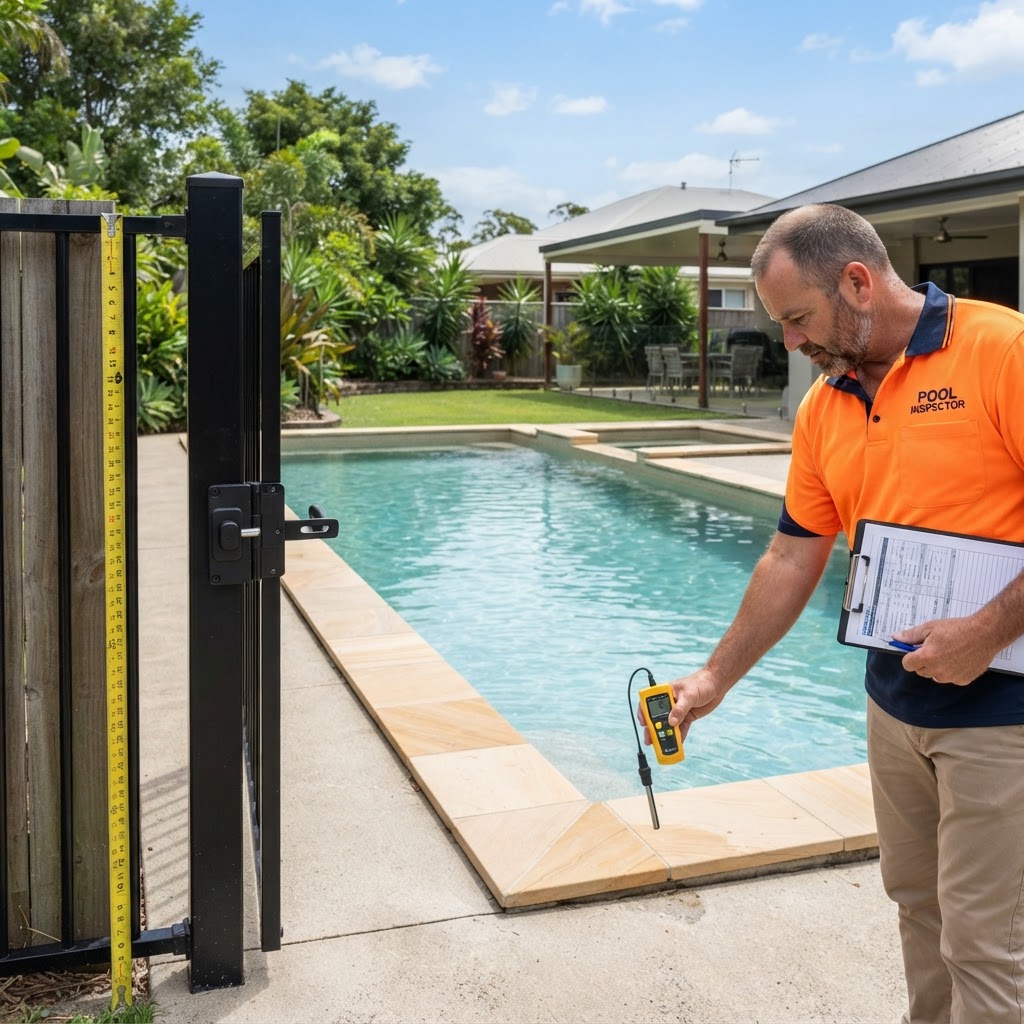
A pool and spa inspection covers structural integrity, water quality, mechanical equipment, and — most critically — safety barriers required by law. Skipping or missequencing checks is the leading cause of non-compliance notices and reinspection costs. This guide walks you through each stage in the correct order so nothing is missed.
Key takeaways
- Pool barrier (fence) compliance is mandatory across Australia (AS 1926.1–2012), the US (IRC Section R326), and the UK (BS EN 13451) — non-compliant barriers are the single most common defect found.
- A full pool and spa inspection typically takes 45–90 minutes for a residential property and should be documented with timestamped photos.
- Water chemistry must be tested on-site; do not rely on the owner's verbal report.
- Mechanical equipment (pump, filter, heater, chlorinator) must be checked under load, not just visually inspected.
- Local councils in Australia require barrier compliance certificates before a property with a pool can be sold or leased.
Why Pool and Spa Inspections Matter
Drowning remains one of the leading causes of accidental death in children under five in Australia, the US, and the UK. Regulators in all three markets have responded with prescriptive requirements around pool safety barriers, drain covers, and water treatment. For inspectors, this means a pool or spa inspection is never just a maintenance check — it is a compliance audit with potential legal consequences if defects are missed.
For property managers and strata managers, a defective pool can void public liability insurance and expose the owners corporation to significant claims. For insurance adjusters, an undocumented pool condition can complicate or deny a claim. Getting the inspection right — and documenting it rigorously — protects every party.
Before You Arrive: Preparation Checklist
Good fieldwork starts before you leave the office.
- Review applicable standards. In Australia, use AS 1926.1–2012 (safety barriers) and AS 1926.2–2007 (location of safety barriers). In the US, consult your state pool code plus the 2021 IRC Section R326. In the UK, refer to BS EN 13451 and the Health and Safety Executive's Managing Health and Safety in Swimming Pools guidance.
- Confirm pool type. In-ground concrete, above-ground, fibreglass, and spa/hot tub each have different structural and equipment checks.
- Gather equipment. Bring a water test kit or digital meter (pH, free chlorine, total alkalinity, cyanuric acid, TDS), a tape measure, a gate latch force gauge, a torch, a non-contact thermometer, and a camera.
- Check council records. Confirm whether a compliance certificate exists, when it was last issued, and whether any notices of non-compliance are on file.
- Brief the client. Ask them to run the pump and filtration system for at least two hours before your arrival so you can assess equipment under normal operating load.
Stage 1: Safety Barrier Inspection
The barrier inspection must come first. A non-compliant barrier is an immediate risk and, in most Australian jurisdictions, a mandatory report to council regardless of the rest of the inspection outcome.
Fence Height and Construction
Under AS 1926.1–2012, a child-resistant barrier must be at least 1,200 mm high measured on the outside of the fence. Check every panel — height can vary if ground levels change. The barrier must not be climbable: horizontal rails on the outside face must not be spaced so as to provide footholds. Measure any horizontal rail spacing; gaps greater than 10 mm between rails on the climbable face are non-compliant.
In the US, the IRC requires pool barriers to be at least 48 inches (1,219 mm) high. In the UK, no single national height standard exists, but BS EN 13451 and local authority guidance typically reference 1,200 mm for residential pools.
Gates and Latches
This is where most failures occur. Check each gate for:
- Self-closing mechanism: The gate must return to the latched position from any open angle without assistance. Test from fully open (90°) and partially open (45°).
- Self-latching mechanism: The latch must engage automatically. Under AS 1926.1, the latch must be located on the pool side of the gate, at least 1,500 mm above the ground, OR be a child-resistant type if positioned lower.
- Latch release force: Use a latch force gauge. The release force must require deliberate adult effort — typically a minimum 67 N (15 lbf) under US ASTM F2461 guidance.
- Gate swing direction: Gates must swing away from the pool (outward) or be self-latching in both directions.
Document every gate with a photo showing the latch position and a tape measure confirming height.
Gap and Opening Checks
Measure all gaps in the barrier systematically:
| Location | Maximum permitted gap (AS 1926.1) |
|---|---|
| Between vertical members | 100 mm |
| Under the fence (ground clearance) | 100 mm |
| Between gate and post | 100 mm |
| Between fence and fixed structure | 100 mm |
If a boundary fence forms part of the barrier, it must meet all the same requirements — a common oversight on older properties.
Climbable Objects Within 900 mm
AS 1926.1 requires a 900 mm clear zone on the outside of the barrier, free from objects a child could use to climb over. Check for garden furniture, BBQs, pool equipment boxes, and vegetation. Photograph anything within this zone.
Stage 2: Structural Inspection
Pool Shell and Coping
- Inspect the pool shell for cracks, spalling, delamination (fibreglass pools), or exposed steel reinforcement. Surface crazing (hairline cracks in the surface coating only) is cosmetic; structural cracks that leak water are a defect requiring remediation.
- Check coping stones and tiles for cracking, loose sections, or trip hazards. Run your hand along the edge for sharp edges or chips.
- Inspect the waterline tiles for efflorescence (white mineral deposits indicating water migration) and grout failure.
Surrounds and Decking
- Check for trip hazards: raised edges, cracked pavers, uneven surfaces.
- Confirm adequate drainage fall away from the pool shell (typically 1:100 minimum).
- Inspect non-slip surfaces — worn or missing non-slip coatings near pool steps and entries are a safety defect.
Spa/Hot Tub Specific Checks
- Inspect the shell for delamination, discolouration, or soft spots (fibreglass spas).
- Check the cover locking mechanism; under ASTM F1346 (US) and similar guidance, spa covers must have a lockable child-resistant closure.
- Inspect suction fittings and drain covers. Entrapment by suction (body, hair, limb) is a serious risk. Under the US Virginia Graeme Baker Act, all public and semi-public pools and spas must have compliant anti-entrapment drain covers (ASME/ANSI A112.19.8). For residential pools in Australia, AS 1926 series and manufacturer guidelines apply.
Stage 3: Water Quality Testing
Water chemistry must be tested with a calibrated meter or test kit on the day of inspection. Do not accept the owner's records as a substitute.
| Parameter | Target range (residential) |
|---|---|
| pH | 7.2 – 7.6 |
| Free chlorine | 1 – 3 ppm |
| Combined chlorine | < 0.2 ppm |
| Total alkalinity | 80 – 120 ppm |
| Cyanuric acid (stabiliser) | 30 – 50 ppm (outdoor pools) |
| Calcium hardness | 200 – 400 ppm |
| Water temperature | < 40°C for spas (AS/NZS 3666) |
Record actual readings in your report. Out-of-range values are a maintenance defect and, if significantly out of range (e.g. free chlorine < 0.5 ppm or pH > 8.0), a health risk that should be flagged prominently.
Stage 4: Mechanical Equipment Inspection
Pump and Filter
- Confirm the pump is operating under load (the client should have run it for at least two hours prior to inspection).
- Check for leaks at the pump housing, strainer lid, and pipe connections.
- Listen for unusual noise: cavitation (gurgling/rattling) indicates a blockage or air ingestion. Bearing noise (grinding) indicates pump wear.
- Inspect the filter (sand, cartridge, or DE): check pressure gauge reading. A pressure more than 10 psi above the clean baseline indicates the filter needs backwashing or cleaning — not a defect per se, but a maintenance note.
- Check filter media age: sand media should be replaced every 5–7 years; cartridges every 1–3 years depending on use.
Chlorinator and Chemical Dosing
- For saltwater (salt chlorine generator) pools: check salt level (typically 3,000–4,500 ppm) and inspect the electrolytic cell for scale buildup.
- Inspect chemical storage: chemicals should be stored in a cool, dry, ventilated area, clearly labelled, and segregated (oxidisers separate from chlorine products). Improper storage is a safety defect.
Heating Systems
- Test heater operation by running through a heating cycle.
- Inspect flue (gas heaters) for blockage, corrosion, or improper clearance from combustibles.
- Check heat pump for refrigerant leaks (oil staining on pipework) and airflow obstruction.
Lighting
- Test all underwater lights. Inspect for cracked lenses or signs of water ingress in the niche.
- Confirm lights are on a safety extra-low voltage (SELV) circuit (12V or 24V AC/DC) — standard requirement under AS/NZS 3000 (Australia) and NEC Article 680 (US).
Electrical Safety
- Confirm a residual current device (RCD/GFCI) is installed and tested on all pool electrical circuits. In Australia, AS/NZS 3000 and state electrical regulations require RCD protection on all pool circuits.
- Note the location of the isolation switch and confirm it is accessible and labelled.
Stage 5: Documentation and Reporting
A pool and spa inspection is only as useful as the report it produces. Each defect must be:
- Photographed — timestamped, clearly showing the defect, with a reference object (tape measure, coin) for scale where relevant.
- Classified — safety/barrier non-compliance, structural defect, mechanical defect, or maintenance item.
- Referenced to a standard — cite the specific clause of AS 1926.1, IRC Section R326, or whichever standard applies.
- Actioned — every defect should have a recommended action and, where possible, an urgency rating (immediate, within 30 days, routine maintenance).
Using a platform like Inspectra AI allows you to capture voice notes and photos in the field and generate a structured, professional report in minutes — with all findings organised by category and severity. This reduces report turnaround from hours to under 30 minutes and eliminates the risk of field notes being lost or misread.
Common Defects Found During Pool Inspections
Based on field data, the most frequently cited defects are:
- Gate latch height non-compliance — latch below 1,500 mm on pool side without being child-resistant type (approximately 40% of inspections in older properties)
- Ground clearance under fence > 100 mm due to soil erosion
- Climbable objects within 900 mm of barrier exterior
- Out-of-range water chemistry — most commonly low free chlorine or elevated cyanuric acid
- Cracked or loose coping creating trip hazard
- Missing or non-compliant drain covers on spas
- Absence of RCD on pool electrical circuits in pre-1990s installations
Frequently Asked Questions
How long does a pool inspection take?
A residential pool or spa inspection typically takes 45–90 minutes on-site, depending on pool size, number of barriers, and complexity of the mechanical plant. Allow additional time for report preparation unless you are using a digital reporting platform.
Do I need a separate compliance certificate for a pool barrier?
In Australia, yes. Most states and territories require a pool barrier compliance certificate (issued by a council inspector or accredited certifier) before a property with a pool can be sold or leased. A building or pre-purchase inspector can identify defects, but the compliance certificate must be issued by the relevant authority. Requirements vary by jurisdiction — check your state's pool safety legislation.
What water temperature is safe for a spa?
Under AS/NZS 3666 and general health guidance, spa water temperature should not exceed 40°C for healthy adults, and 38°C is recommended for prolonged use. Temperatures above 40°C carry risks of hyperthermia, particularly for children, pregnant women, and people with cardiovascular conditions. Always test with a calibrated thermometer, not the spa's built-in display.
Can I fail an inspection for a cracked pool shell?
It depends on the nature of the crack. Surface crazing or minor cosmetic cracks in plaster or fibreglass gel coat are typically noted as maintenance items, not failures. Structural cracks — those that pass through the shell and result in water loss or expose reinforcement — are material defects that require remediation and should be referred to a structural engineer or pool builder.
What standards apply to pool inspections in the UK?
The UK does not have a single prescriptive residential pool barrier standard equivalent to AS 1926.1 or the IRC. Inspectors should reference BS EN 13451 (safety requirements for swimming pool equipment), the HSE's Managing Health and Safety in Swimming Pools (for semi-public pools), and relevant local authority planning conditions. For private residential pools, document barrier height, gate self-closing and self-latching, and electrical compliance under BS 7671 (18th Edition).
How often should a pool and spa be professionally inspected?
For residential rental properties in Australia, pool barrier compliance must be verified at each change of tenancy and at least every three years under the relevant state pool safety laws. For owner-occupied properties, an annual professional inspection is considered best practice. Insurance adjusters typically require an inspection following any weather event or when a claim involves the pool area.
Bottom Line
A pool and spa inspection is a structured, standards-referenced process — not a visual walk-around. Work through the five stages in order: safety barrier, structure, water quality, mechanical equipment, and documentation. Photograph every defect with a reference for scale, cite the applicable standard, and classify by severity.
If you want to cut report preparation time and produce consistent, professional output from your field notes and photos, start a free trial with Inspectra AI and see how quickly a compliant pool inspection report can be ready for your client.