
All articlespre-purchase inspection
Pre-Purchase Property Inspection: What Reports Miss
Inspectra AI Team October 14, 2026 10 min read
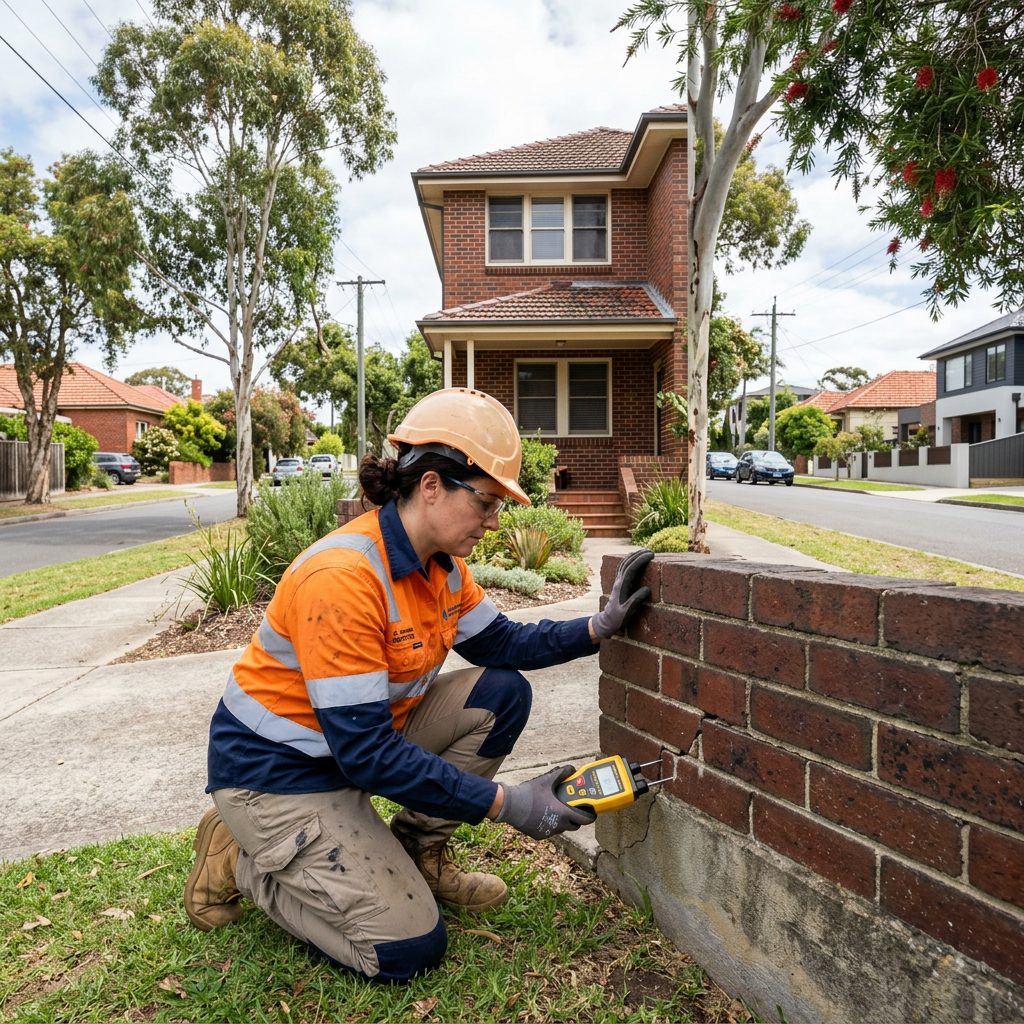
A pre-purchase property inspection report is only as useful as what it actually captures. Too many reports satisfy minimum compliance but leave buyers, solicitors, and insurers without the detail they need to make informed decisions — and leave inspectors exposed when disputes arise later.
Most jurisdictions set a floor, not a ceiling, for what inspectors must document. AS 4349.1-2007 in Australia, for example, defines a building inspection as a visual inspection of accessible areas — which means anything behind a locked door, under a concrete slab, or above an inaccessible ceiling space is technically outside scope. InterNACHI's Standards of Practice in the US take a similar approach.
The problem is that buyers often don't understand this. They receive a 30-page report and assume it is comprehensive. When a defect surfaces six months post-settlement — rising damp behind a tiled wall, deteriorating stumps in a partially accessible subfloor, or inadequate drainage grading — the report becomes evidence in a dispute.
The gap is not always negligence. It is usually inadequate documentation of scope boundaries, insufficient photographic records, and vague defect language that cannot support a cost estimate or a repair decision.
Subfloor inspections are among the highest-risk areas for incomplete reporting. Inspectors in Australia are required under AS 4349.1 to inspect subfloor areas where safe and reasonable access exists — defined as a minimum 600 mm × 600 mm access opening and 400 mm of crawl space. When access is restricted, the report must say so explicitly, with photographs of the access point.
What often goes undocumented:
Roof void inspections require a minimum 600 mm × 500 mm manhole (AS 4349.1). Where access is present, inspectors should document:
For the external roof surface, a ground-level or drone observation may not capture cracked tiles, failed sealant at penetrations, or inadequate flashing at abutments. Reports should clearly state the observation method and its limitations.
Poor site drainage is consistently underreported yet is one of the leading contributors to subfloor moisture, footing movement, and structural damage over time. Inspectors should document:
Visual identification of moisture is unreliable without instrumentation. A calibrated moisture meter (pin or non-invasive) should be used at all ground-level walls, wet areas, and subfloor-adjacent surfaces. Document:
Every pre-purchase report should open with a scope statement that specifies:
This is not boilerplate — it is the first line of defence if a client later claims the report should have identified a defect that was outside accessible scope.
Vague language creates disputes. Compare:
"Some cracking noted to external brickwork."
vs.
"Horizontal cracking to eastern external brick wall, approximately 4–6 mm width at DPC level, extending 1.2 m from the north-eastern corner. Consistent with differential footing movement. Recommend geotechnical assessment before settlement."
The second version is actionable. It supports cost estimation, informs a solicitor's negotiation, and demonstrates the inspector's competence.
| Vague term | Preferred alternative | |---|---| | "Some cracking" | Crack width in mm, location, and direction | | "Evidence of moisture" | Moisture meter reading (%), location, affected area in m² | | "Roof in fair condition" | Specific defects noted, observation method, accessible area percentage | | "Subfloor area not inspected" | Access point dimensions, reason for exclusion, photograph reference |
A rule of thumb: if you mention it in the report, there should be a photograph. For pre-purchase inspections, photos should include:
Photographs embedded adjacent to the relevant finding — not collected in an appendix — are significantly more useful to readers and harder to dispute.
Ariving on site unprepared wastes time and introduces risk. Before attending a pre-purchase inspection, confirm:
In Australian states, unapproved structures (decks, carports, extensions) are a common finding that can affect a buyer's ability to obtain insurance or council approval. Noting permit status or recommending council record checks adds significant value to a report.
One of the practical challenges in pre-purchase inspection reporting is the gap between what an inspector observes in the field and what ends up in the written report. Field notes taken under time pressure — particularly on voice recorders or handwritten forms — frequently lose nuance during transcription.
Platforms like Inspectra AI are designed to close this gap by converting voice notes, photos, and field observations into structured, professional report language. For inspectors working at volume, this reduces the risk of defects being described inconsistently across reports and helps maintain measurable, defensible language standards.
This matters for pre-purchase inspections specifically because the reports are used by legal professionals, valuers, and insurers — not just the buyer. A report that reads as thorough and structured carries more weight in a dispute than one that reads as a hasty dictation.
AS 4349.1-2007 is the primary standard. Reports must distinguish between major defects (structural or safety-significant) and minor defects. Timber pest inspections are conducted separately under AS 4349.3-2010 and should not be combined into a single report unless the inspector holds the appropriate licence.
InterNACHI's Standards of Practice and ASHI's (American Society of Home Inspectors) Standard of Practice both define a home inspection as non-invasive and visual. State licensing requirements vary significantly — over 30 states require inspector licensing. Reports should identify systems inspected, systems not inspected, and any component limitations.
RICS HomeSurvey Level 2 (previously Homebuyer Report) and Level 3 (Building Survey) define the scope tiers. Level 2 is appropriate for conventional properties in reasonable condition; Level 3 is recommended for older, extended, or structurally complex buildings. RICS members are bound by the Surveyors and the Law guidance and should clearly indicate condition ratings (1–3) for each element.
A pre-purchase property inspection is a formal assessment of a property's condition carried out before a buyer completes a purchase. It identifies defects, safety issues, and maintenance concerns, and is typically conducted against a published standard such as AS 4349.1 (Australia), InterNACHI SOP (US), or RICS HomeSurvey Level 2/3 (UK).
Areas that are inaccessible, locked, or unsafe to enter are typically outside scope. This includes concealed spaces behind finishes, areas below concrete slabs, and electrical or plumbing components within walls. The inspector must document all exclusions clearly in the report.
For a standard residential property, allow 1.5 to 3 hours on site depending on size, age, and complexity. Older homes, those with large subfloor areas, or properties with significant observable defects may take longer. Report preparation adds another 1–3 hours.
No. A visual inspection conducted within the standard scope cannot identify concealed defects, latent defects (defects not yet visible), or issues requiring invasive investigation. Inspectors should recommend specialist assessments — such as structural engineering, geotechnical reports, or plumbing camera inspections — where there is observable evidence warranting further investigation.
In Australia, building and pest inspections are separate reports conducted under different standards (AS 4349.1 and AS 4349.3 respectively) and often require separate licences. In the US and UK, inspectors may note visible evidence of pest activity within the building inspection, but a specialist pest or timber report may still be recommended.
Document what is visible, the observation method, and why precise measurement was not possible. For example: "Moisture staining observed to base of eastern wall, wet-area origin not confirmed. Non-invasive moisture meter reading of 22% recorded. Invasive investigation recommended." This is more defensible than omitting the observation.
A pre-purchase inspection report that meets minimum standards is not the same as one that serves its reader. The reports that hold up — in negotiations, in disputes, and in court — are those with clear scope definitions, measurable defect descriptions, photographic evidence, and explicit recommendations for follow-up investigation where warranted.
If you're producing pre-purchase inspection reports at volume and want to improve consistency without adding hours to your workflow, start a free trial with Inspectra AI and see how AI-assisted reporting tools can help your team maintain defensible, professional standards on every job.