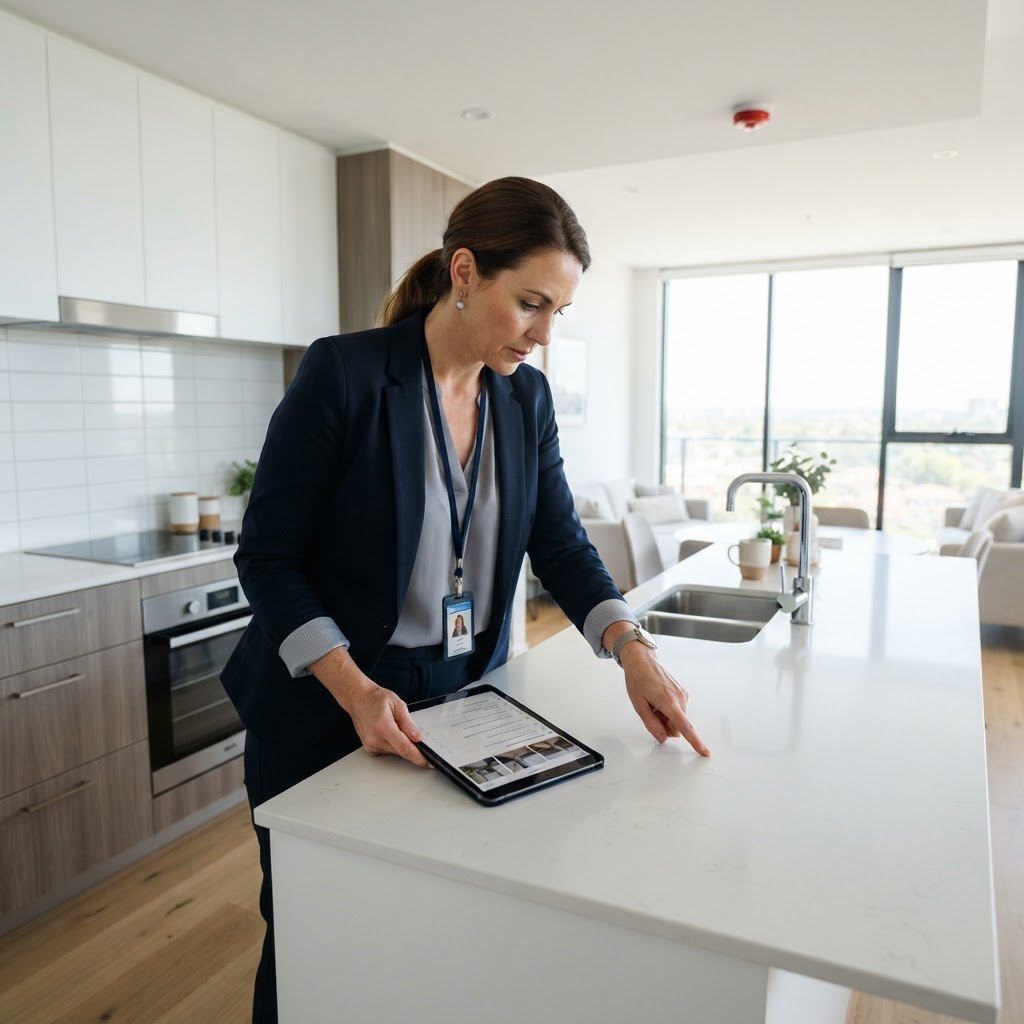
A rental property entry inspection — also called an ingoing condition report — establishes the documented baseline condition of a property before a tenant takes possession. Done properly, it protects both landlord and tenant from disputes at lease end, and it underpins any future insurance or bond claim.
Key takeaways
- Entry inspections must be completed before or on the day the tenant receives keys, not after move-in.
- In Australia, condition reports are a legal requirement under residential tenancy legislation in every state and territory (e.g. Residential Tenancies Act 2010 in NSW).
- In the UK, inventory reports are strongly recommended and referenced in the Tenancy Deposit Scheme (TDS) dispute process.
- In the US, many states (e.g. California Civil Code §1950.5) require written condition documentation at move-in to legally withhold bond or security deposit funds at move-out.
- Photographic evidence tied to each checklist item is the single most effective way to resolve disputes without going to tribunal.
What Is a Rental Property Entry Inspection?
An entry inspection (also called a move-in inspection or ingoing condition report) is a systematic, room-by-room assessment of a rental property's physical condition conducted before a tenancy begins. The inspector — typically a property manager or licensed inspector — documents the state of walls, floors, fixtures, appliances, and all other inclusions. The completed report is signed by both parties and stored for the life of the tenancy.
This differs from a periodic inspection (which checks for maintenance issues mid-tenancy) and a move-out inspection (which compares end condition against the entry baseline). The entry report is the foundational document from which all others are measured.
Why Entry Inspections Fail
Most entry inspection disputes arise from one of three problems:
- Vague condition descriptions — "fair" or "good" without photographic support.
- Missed areas — garages, roof spaces, sub-floors, and external structures are frequently skipped.
- No tenant sign-off — in many jurisdictions, the tenant has 2–5 business days to add their own notes and return the signed report.
Using a structured checklist eliminates gaps and creates a legally defensible record.
Rental Property Entry Inspection Checklist
Work through each section systematically. For every item, record condition using a consistent scale (e.g. New / Good / Fair / Poor / Damaged) and attach dated photographs.
1. External and Site
- Driveway and paths — cracks, trip hazards, staining
- Fencing and gates — stability, latch function, corrosion
- Letterbox — present, lockable, numbered
- Garden and lawn — condition at handover, irrigation system operation
- Outbuildings / sheds — structural integrity, locks, contents (if included)
- Roof (visible from ground) — missing or lifted tiles/sheets, gutters and downpipes clear
- External walls — render cracks, paint condition, weep holes unobstructed
- Garage / carport — door mechanism, remote controls (number provided), floor staining
- Pool or spa — water clarity, pump operation, fencing compliance (AS 1926.1 in Australia; local authority standards in UK/US)
Tip: Photograph the meter box, smoke alarm locations, and any pre-existing damage from at least two angles.
2. Entry and Hallways
- Front door — operation, deadbolt, weather seal
- Walls and ceiling — cracks, stains, scuff marks
- Flooring — scratches, lifting, staining
- Light fittings and switches — operational
- Smoke alarms — present, tested, compliant (in Australia, hardwired or 10-year lithium battery units required under most state legislation)
3. Living and Dining Areas
- Walls — nail holes, marks, paint condition
- Ceiling — water stains, cornice cracks
- Windows — glass condition, lock operation, fly screens intact
- Blinds / curtains — present, operational, condition
- Flooring — carpet (staining, wear), timber (scratches, gaps), tiles (chips, grout condition)
- Power points — present and operational
- Air conditioning — operational, filters clean, remote provided
- Fireplace (if present) — flue condition, damper operation
4. Kitchen
- Benchtops — chips, burns, staining
- Cupboards and drawers — alignment, hinges, interior lining
- Sink and tapware — leaks, water pressure, waste plug
- Splashback — cracked tiles, grout integrity
- Oven and cooktop — operational, burners/elements all functional, door seal
- Rangehood — fan operational, filter condition
- Dishwasher (if included) — operational, door seal
- Refrigerator (if included) — temperature, seals, ice-maker
- Flooring — as above
5. Bedrooms (Repeat for Each)
- Walls and ceiling — marks, stains, cracks
- Built-in wardrobe — doors align, shelving secure, interior condition
- Windows and locks — operational
- Flooring — carpet seams, timber, tiles
- Light fittings, power points, data/TV outlets
- Ceiling fan (if present) — balanced, operational
6. Bathrooms, Ensuites, and Toilets (Repeat for Each)
- Shower screen / bath — glass chips, seal integrity, screen tracks
- Tiles and grout — cracked tiles, mould presence noted (not necessarily tenant's fault at entry)
- Exhaust fan — operational
- Vanity — tapware, basin, cabinet doors
- Toilet — cistern operation, seat condition, base seal
- Towel rails, toilet roll holder — secure
- Waterproofing — no visible signs of membrane failure (bubbling, peeling)
- Mirror — chips, silvering condition
7. Laundry
- Tub and tapware
- Washing machine connections — hot/cold taps operational, drain hose secured
- Dryer connections (if ducted) — duct intact
- Cabinetry
- Flooring — vinyl or tiles, condition
8. Garage and Storage Areas
- Automatic door — operational, remote/fob count
- Manual override function present
- Internal access door (if connected to house) — fire-rated door integrity (critical for AS 1530 / Building Regulations compliance)
- Floor — oil stains, cracks
- Storage shelving — secure
9. Roof Space and Sub-Floor (Where Accessible)
- Roof space — insulation present and even, no visible moisture or pest activity
- Sub-floor (if applicable) — no pooling water, piers intact, no visible termite workings
- These areas are frequently omitted and become dispute flashpoints after storm or pest events.
10. Services and Utilities
| Item | Check |
|---|---|
| Water meter reading | Record at inspection |
| Gas meter reading | Record at inspection |
| Electricity meter reading | Record at inspection |
| Hot water system | Age, type (gas/electric/heat pump), operational |
| Smoke alarms | Tested, compliance sticker present |
| Carbon monoxide detector | Present if gas appliances (required in some UK/US jurisdictions) |
| Security alarm | Code provided, panel condition |
| NBN / broadband connection point | Location noted |
| Pest control history | Last treatment date recorded |
11. Keys and Access Devices
Document every key, remote, fob, swipe card, and access code provided. Record quantities. Tenant signs to confirm receipt.
Condition Rating Definitions
Use consistent terminology throughout the report. Ambiguous terms like "OK" or "reasonable" have no defensible meaning at tribunal.
| Rating | Definition |
|---|---|
| New | No signs of use or wear |
| Good | Minor wear consistent with age; no damage |
| Fair | Moderate wear; minor cosmetic damage not affecting function |
| Poor | Significant wear or damage; functionality affected |
| Damaged | Broken, missing, or non-functional |
Photography Standards for Entry Reports
Photographs are admissible evidence in tenancy tribunal proceedings in Australia (NCAT, VCAT, QCAT), UK (First-tier Tribunal), and US small claims courts. Follow these standards:
- Date and time stamp every image (use your inspection app or camera settings).
- Capture wide-angle room shots first, then close-ups of specific defects.
- Photograph meter readings, key counts, smoke alarm locations, and appliance serial numbers.
- Minimum 3 megapixels per image; natural or consistent artificial lighting.
- Store images linked to the specific checklist item, not in a generic folder.
Inspectra AI automatically geo-tags and time-stamps photos, links them to individual checklist line items, and generates a formatted condition report ready for tenant sign-off — reducing report preparation time from hours to minutes.
Legal Requirements by Region
Australia
- Condition reports are mandatory in all states/territories.
- Tenant typically has 3–5 business days to review, annotate, and return.
- NSW: Residential Tenancies Act 2010 and Regulation 2019.
- QLD: Residential Tenancies and Rooming Accommodation Act 2008.
- VIC: Residential Tenancies Act 1997 (amended 2021 — stricter minimum standards).
United Kingdom
- No statutory requirement, but strongly recommended and referenced by TDS, DPS, and MyDeposits in dispute adjudication.
- Use an independent inventory clerk for high-value properties.
- RICS guidance recommends photographic inventories at both check-in and check-out.
United States
- Requirements vary by state. California, Washington, and Georgia explicitly require written move-in condition statements to withhold security deposit funds.
- Always check local landlord-tenant statutes; some jurisdictions (e.g. Chicago) have specific form requirements.
Common Items That Get Missed
- Fly screens — torn or missing screens are a common bond dispute item.
- Garage door remotes — quantity not documented leads to end-of-tenancy charges.
- Exhaust fans — not tested; mould discovered at move-out attributed incorrectly to tenant.
- Sub-floor and roof space — skipped entirely; storm or pest damage contested.
- Window restrictors (child safety devices) — required in some jurisdictions above certain floor heights.
- External taps — leaking at entry but not noted.
Frequently Asked Questions
How long does a rental property entry inspection take?
For an average 3-bedroom house, a thorough entry inspection takes 60–90 minutes on-site plus report preparation time. Using digital inspection software with pre-built templates can cut total time to under 60 minutes including the report.
Does the tenant need to be present at the entry inspection?
In most Australian states, tenants do not need to be present — the agent completes the report and the tenant has a statutory period (usually 3–5 business days) to add their own comments and return the signed copy. In the UK and US, practice varies, but joint sign-off reduces disputes.
What happens if the tenant disagrees with the entry condition report?
The tenant should note their disagreement in writing on the report within the allowed timeframe and return a signed copy. Their annotations become part of the official record. If disputes arise at end of tenancy, tribunals consider both sets of notes alongside photographic evidence.
Can I use the entry inspection report for insurance claims?
Yes. A well-documented entry condition report with dated photographs can support an insurance claim for malicious damage or landlord contents. Insurers may request the report as evidence that damage did not exist prior to the tenancy.
How many photos should I take during an entry inspection?
There is no maximum. A typical 3-bedroom property should yield 80–150 photos minimum. Focus on every room (wide shot + detail shots of any defects), all appliances, meters, keys, and any pre-existing damage.
Are digital condition reports legally valid?
Yes, in Australia, UK, and US. Digital reports with electronic signatures, geo-tagged photos, and audit trails are accepted by tenancy tribunals. Ensure your platform stores an immutable, time-stamped record.
Bottom Line
A rental property entry inspection is not a formality — it is a legally significant document that determines who pays for what at the end of a tenancy. The checklist above covers every area that inspectors commonly miss, and the photography and rating standards give your report the evidentiary weight it needs if a dispute reaches tribunal.
If you're managing multiple properties or conducting inspections at scale, start a free trial with Inspectra AI to generate consistent, defensible entry condition reports from site photos and voice notes — without spending hours at the desk.