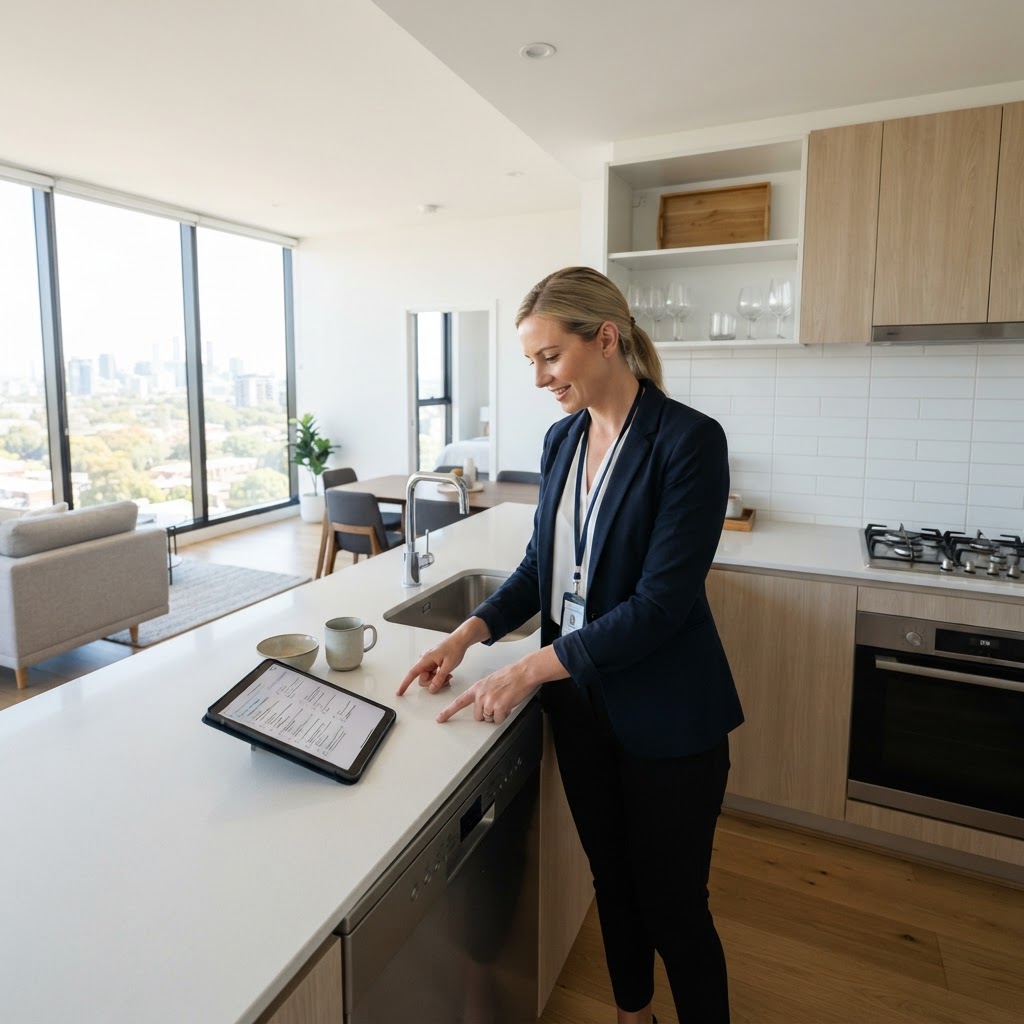
A thorough rental property inspection protects landlords from costly disputes, helps tenants receive fair bond refunds, and ensures properties meet habitability standards. This room-by-room checklist covers every major system and surface a property manager or inspector should assess at entry, routine, and exit inspections.
Key takeaways
- Entry (ingoing) and exit (outgoing) inspections must be documented with dated photos and written condition reports to support bond claims in most Australian, US, and UK jurisdictions.
- Routine inspections in Australia are typically limited to one every three months under residential tenancy legislation; in the UK, 24–48 hours written notice is required.
- AS 4349.0 (Inspection of Buildings) provides the Australian framework for property condition reporting; UK inspectors commonly reference RICS Home Survey Standards.
- Water damage, mould, and electrical defects are the three most frequently disputed items at tenancy exit — prioritise these in documentation.
- AI-assisted platforms like Inspectra AI can convert site photos and voice notes into structured reports in minutes, reducing report preparation time by up to 70%.
Why a structured rental inspection checklist matters
A rental property inspection — also called a condition inspection or tenancy inspection — is a formal assessment of a property's physical state at a defined point in the tenancy lifecycle. Without a consistent, room-by-room framework, inspectors miss items, documentation is incomplete, and disputes become difficult to resolve.
In Australia, the Residential Tenancies Act in each state requires a condition report at the start of every tenancy. In England and Wales, the Tenancy Deposit Scheme (TDS) relies on check-in and check-out inventories to adjudicate bond disputes. In the US, most states require written move-in condition statements, with some — such as California (Civil Code §1950.5) — mandating pre-move-out inspections.
A standardised checklist also supports fair wear and tear assessments. Fair wear and tear refers to the gradual, reasonable deterioration of a property through normal use — as distinct from tenant damage. Documenting baseline condition with timestamped photos is the only reliable way to distinguish one from the other.
When to conduct each inspection type
| Inspection type | Timing | Notice required (AU) | Notice required (UK) | Notice required (US) |
|---|---|---|---|---|
| Entry / ingoing | Before or on move-in day | Not required | Not required | Not required |
| Routine | Every 3 months (max) | 7–14 days written | 24–48 hours written | 24–48 hours (varies by state) |
| Exit / outgoing | Within 3 days of vacating | Not required | Not required | Not required |
| Maintenance follow-up | After repairs completed | 24 hours (varies) | 24 hours | 24 hours (varies) |
Room-by-room rental property inspection checklist
Use this checklist at entry and exit inspections. Rate each item: Satisfactory (S), Requires Attention (RA), or Damaged (D). Photograph every item rated RA or D.
Entry / front of property
- [ ] Letterbox — secure, labelled, undamaged
- [ ] Driveway and paths — cracking, trip hazards, oil stains
- [ ] Fencing and gates — structural integrity, latches, paint condition
- [ ] Garden beds and lawn — condition consistent with lease obligations
- [ ] External walls — render cracks, efflorescence (salt deposits on masonry), paint peeling
- [ ] Roof visible from ground — missing tiles, sagging gutters, downpipe condition
- [ ] Garage door — operation, remote function, safety auto-reverse
Living areas and hallways
- [ ] Walls and ceilings — cracks (note width; >2 mm may indicate structural movement per AS 2870), stains, paint condition
- [ ] Floors — scratches, lifting edges on floating floors, staining on carpet, tile grout condition
- [ ] Windows — operation, locks, fly screens, glass chips or cracks
- [ ] Doors — latches, hinges, draught seals, condition of frames
- [ ] Skirting boards and architraves — damage, paint, gaps at floor junctions
- [ ] Light fittings — all globes operational, no exposed wiring
- [ ] Power points and switches — covers intact, no scorch marks
- [ ] Curtains and blinds — operation, condition, missing components
- [ ] Smoke alarms — test function, note battery type and expiry
Compliance note: In Australia, AS 3786:2014 governs smoke alarm specifications. Queensland mandates interconnected photoelectric smoke alarms in all rental properties as of January 2022. Scotland requires interlinked alarms under the Fire (Scotland) Act 2005.
Kitchen
- [ ] Benchtops — burns, chips, cuts, delamination
- [ ] Cupboards and drawers — hinges, runners, handles, internal lining
- [ ] Sink and tapware — leaks, water pressure, waste plug, waste pipe condition
- [ ] Splashback — tiles intact, grout condition, silicone seal
- [ ] Rangehood — filter condition, fan operation, ducting
- [ ] Oven and cooktop — burner/element function, seals, cleanliness at entry
- [ ] Dishwasher (if included) — cycle function, door seal, filter condition
- [ ] Refrigerator (if included) — temperature, door seals, defrost drain
- [ ] Exhaust fan — operation, cleanliness
- [ ] Under-sink cabinet — evidence of past leaks, pest activity
Bathrooms and ensuites
- [ ] Basin, toilet, and bath/shower — chips, staining, flush function, water pressure
- [ ] Tapware and shower rose — leaks at base and spout, operation
- [ ] Grout and silicone — cracking, mould (note extent; >1 m² of mould may trigger remediation obligations under UK Awaab's Law 2023)
- [ ] Exhaust fan — adequate ventilation, operation
- [ ] Mirror and vanity — condition, fixings
- [ ] Towel rails and toilet roll holders — fixed securely
- [ ] Floor and wall tiles — cracks, hollow tiles (tap test)
- [ ] Waterproofing — note any damp patches on adjacent walls; inspect beneath vanity
- [ ] Shower screen or curtain — seals, rollers, condition
Bedrooms
- [ ] Walls and ceilings — as per living areas
- [ ] Built-in wardrobes — door operation, shelving, rod condition, internal lining
- [ ] Windows and flyscreens — operation, locks, security latches
- [ ] Carpet or flooring — staining, wear patterns, lifting edges
- [ ] Ceiling fan (if installed) — balance, speed settings, blade condition
- [ ] Power points — condition, quantity per room (minimum 2 double GPOs recommended in AU)
Laundry
- [ ] Trough and tapware — condition, hot and cold supply
- [ ] Washing machine connections — hose condition, no leaks
- [ ] Dryer vent (if installed) — clear, lint-free
- [ ] Cabinetry and shelving — condition
- [ ] Floor — waterproofing, drainage
Garage and storage areas
- [ ] Floor — oil stains, cracks, tripping hazards
- [ ] Shelving — fixed, load-bearing, safe
- [ ] Electrical — GPO function, lighting
- [ ] Fire separation wall (attached garages) — integrity, self-closing door function (required under NCC/BCA Section C in Australia)
Utilities and building services
- [ ] Switchboard — labelled circuits, no exposed wiring, RCD/GFCI test button operational
- [ ] Hot water system — age (note; typical lifespan 8–12 years), condition, TPR valve (temperature pressure relief valve) present and unobstructed
- [ ] Gas meter and isolating valve — accessible, no evidence of corrosion or leaks
- [ ] Air conditioning — filter condition, remote present, test cooling and heating modes
- [ ] Ceiling insulation access hatch (if visible) — sealed, no pest entry
- [ ] Roof space (if safe to access) — insulation coverage, no water ingress staining on rafters
Documenting findings: best practices
Photography standards
Every defect should be captured with:
- A wide-angle shot showing location context (e.g. which wall, which room)
- A close-up shot showing the defect detail
- A measurement reference where relevant (ruler, coin, or hand for scale)
Photo metadata — timestamp and GPS coordinates — is admissible evidence in tenancy tribunal proceedings in Australia (NCAT, VCAT, SAT) and in UK TDS adjudications.
Condition rating and written notes
Avoid vague language. Instead of *