
All articlessolar panel inspection
Solar Panel Inspection Cost: A Complete Pricing Guide
Inspectra AI Team September 25, 2026 9 min read
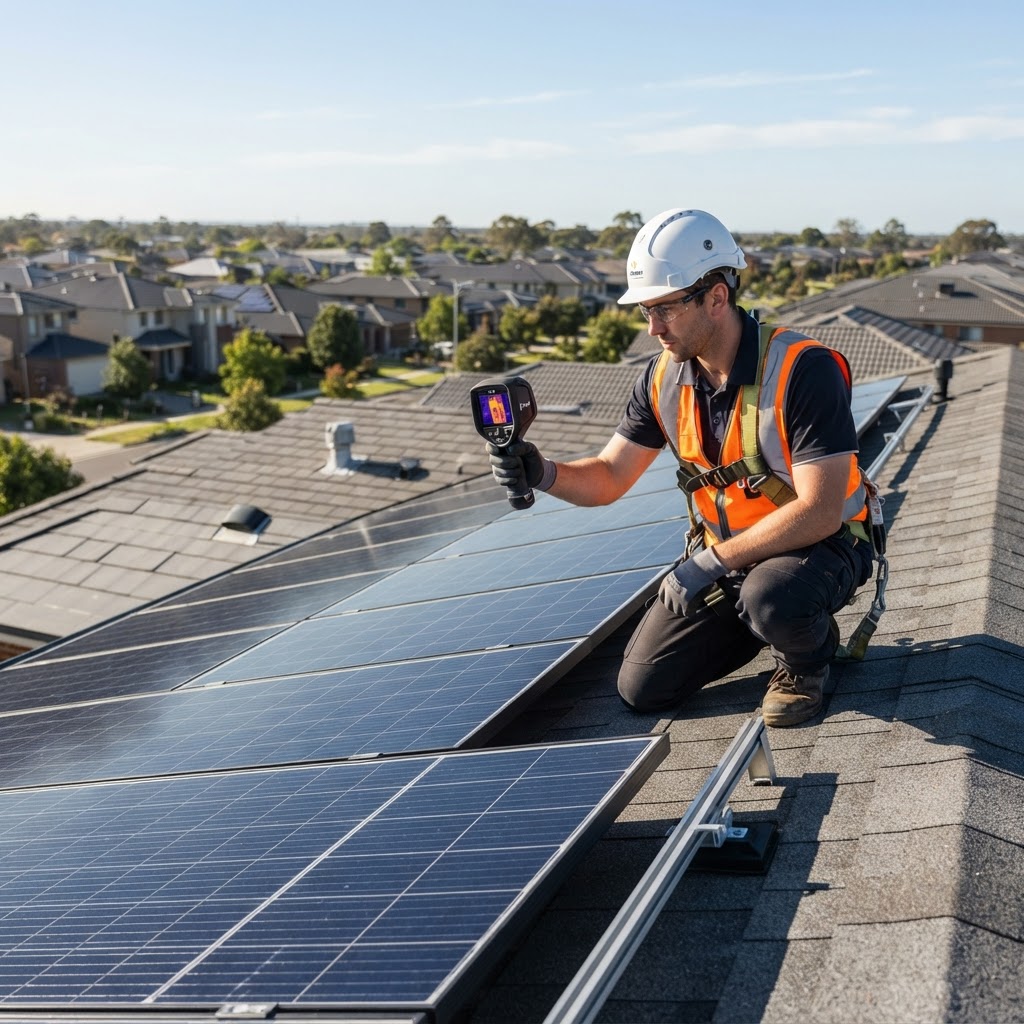
A professional solar panel inspection typically costs between $150 and $600 AUD (or roughly $100–$400 USD / £80–£320 GBP), depending on system size, inspection type, and location. Thermal imaging and comprehensive electrical audits push prices toward the top of that range, while basic visual inspections sit at the lower end. Understanding what drives the price helps you budget accurately and avoid paying for services you don't need.
Pricing isn't arbitrary. Inspectors factor in several variables before quoting a job.
The most direct cost driver is how many panels are on the roof. A 6.6 kW residential system typically has 16–20 panels. A 100 kW commercial array has 250–300+. Most inspectors price per panel ($8–$15 AUD per panel) or per kW ($20–$40 AUD per kW) once the system exceeds a certain threshold.
Not all solar inspections are the same. There are three main types:
| Inspection Type | What's Covered | Typical Cost (AUD) | |---|---|---| | Visual / basic | Physical condition, mounting hardware, visible wiring | $150–$250 | | Electrical audit | IV curve testing, isolator checks, inverter performance data | $250–$450 | | Thermographic (infrared) | Hotspot detection, cell-level defects, delamination | $350–$600+ | | Combined (all three) | Comprehensive report suitable for insurance or legal use | $500–$900+ |
Thermographic inspection uses an infrared camera to detect heat anomalies in individual cells — a method recommended under IEC 62446-3 (the international standard for infrared testing of photovoltaic systems). It adds cost but identifies failures invisible to the naked eye.
Inspectors in regional or remote areas often apply a travel surcharge of $50–$150 AUD per job. In the US, rural properties outside major metro areas can add $75–$200 USD. In the UK, travel beyond 50 miles commonly adds £50–£100 to the invoice.
Steep-pitch roofs (above 30°), multi-storey buildings, or systems with poor access paths require additional safety equipment and time. Expect a 10–20% premium for difficult-access sites.
A basic checklist report is usually included in the base price. A detailed written report with annotated photos, thermal images, and compliance commentary — the kind required for insurance claims, strata disputes, or pre-purchase due diligence — typically adds $50–$150 AUD to the fee. Same-day or 24-hour turnaround can add another $50–$100.
Australia has one of the highest rates of rooftop solar adoption globally, which keeps inspection pricing competitive. Clean Energy Council (CEC) accredited inspectors are the benchmark for quality; always verify accreditation before booking.
Compliance checks should reference AS/NZS 5033:2021 and AS 4777.1:2016. Some state jurisdictions (notably Victoria and Queensland) have additional grid-connection requirements that can extend inspection time.
Pricing varies significantly by state. California, Arizona, and Florida — high-solar-adoption states — have more competition and slightly lower rates than the national average.
Inspectors working to InterNACHI Standards of Practice or NABCEP (North American Board of Certified Energy Practitioners) certification command a premium but provide documentation that holds up in insurance and legal contexts. NEC Article 690 governs photovoltaic system safety requirements.
UK solar inspection pricing is influenced by the Microgeneration Certification Scheme (MCS), which sets quality standards for installers and inspectors.
For systems connected to the grid, inspectors should reference BS EN 62446-1:2016 (commissioning and documentation) and the G99 / G98 connection standards.
Knowing when to inspect — not just what it costs — protects your investment.
Most manufacturers and industry bodies recommend a professional inspection every 2–3 years for residential systems and annually for commercial systems. This cadence is consistent with guidance from the Clean Energy Council (Australia), SEIA (US), and MCS (UK).
Hail, high winds, and falling debris can cause microcracks in cells that reduce output without being visually obvious. An inspection after a significant weather event — especially one with hailstones above 20mm — is worth the cost. Insurance adjusters frequently require a thermographic report before approving storm-damage claims.
If you're buying a property with an existing solar system, a standalone solar inspection ($150–$350 AUD) is cheap insurance. A degraded or non-compliant system can cost $3,000–$15,000 AUD to remediate or replace.
If your monitoring data shows generation has dropped more than 10–15% below expected output (accounting for seasonal variation), an inspection is warranted. Inverter logs and smart monitoring apps make this easy to track.
Most panel manufacturers offer 25-year performance warranties. Making a valid claim typically requires documented evidence of defect — which means an inspection report from a qualified inspector, not just a screenshot of your monitoring app.
Getting three quotes is standard practice. When comparing them, look beyond the headline number.
Ask each inspector:
Red flags to watch for:
Solar panels and the roof membrane they're mounted on are interdependent. Many building inspectors can cover both in a single site visit, reducing combined cost by 15–25% compared to booking separately. This is especially relevant for strata managers overseeing multi-unit buildings.
Some inspection firms offer annual or biennial service contracts for commercial portfolios. These typically discount per-inspection rates by 10–20% in exchange for volume or schedule commitment.
Inspectors using platforms like Inspectra AI can complete and deliver reports faster, which reduces billable time on admin — savings that quality-conscious firms pass on to clients. Digital tools also produce more consistent, defensible documentation.
If you manage a strata property where multiple owners have rooftop systems, negotiating a group inspection day can cut per-unit costs significantly.
Regardless of what you pay, a professional solar inspection report should contain:
A report missing any of these elements is unlikely to satisfy insurers, strata committees, or solicitors in a dispute context.
For a typical residential system (5–10 kW) in Australia, expect to pay $150–$350 AUD for a visual and electrical inspection. In the US, the equivalent is $100–$250 USD; in the UK, £80–£200 GBP. Adding thermographic testing pushes the price $100–$200 higher in each market.
A residential inspection typically takes 2–4 hours on site, including roof access, testing, and preliminary documentation. Large commercial systems can take a full day or more. Report preparation adds 1–3 hours off site, depending on complexity.
You can perform a basic visual check — looking for obvious physical damage, soiling, or shading — but electrical testing and thermographic analysis require licensed electricians and specialist equipment. Self-inspection is not sufficient for insurance claims, warranty disputes, or compliance sign-offs.
Every 2–3 years for residential systems is the standard recommendation from the Clean Energy Council and most manufacturers. Commercial systems benefit from annual inspections. Always inspect after major storm events or if output monitoring shows an unexplained performance drop.
Yes. Insurers handling storm damage, fire, or performance disputes typically require a written inspection report from a qualified professional. A thermographic report is particularly valuable as it provides evidence of cell-level defects that are otherwise undetectable. Reports generated through platforms like Inspectra AI produce consistent, photo-supported documentation that meets most insurer requirements.
The terms are often used interchangeably, but a solar audit typically implies a more comprehensive review — including financial performance analysis, shading assessments, and yield modelling — in addition to physical and electrical inspection. Audits cost more ($500–$1,500 AUD for residential) and are more common in commercial contexts or when refinancing a property.
Solar panel inspection costs range from $150 for a basic residential visual check to $5,000+ for a large commercial thermographic audit. The price is driven by system size, inspection type, location, and report complexity. For most residential and strata clients, a combined visual and electrical inspection every two to three years — costing $200–$400 AUD — is the practical baseline.
The cost of skipping an inspection is almost always higher than the inspection itself: degraded systems, voided warranties, failed insurance claims, and compliance breaches are expensive problems with straightforward preventive solutions.
If you're managing multiple properties or running a high-volume inspection practice, streamlining your reporting workflow makes a measurable difference to turnaround time and client satisfaction. Start a free trial with Inspectra AI to see how AI-assisted reporting can cut report preparation time in half.