
All articlessolar panel inspection
Solar Panel Inspection Report Writing: A Field Guide
Inspectra AI Team November 9, 2026 10 min read
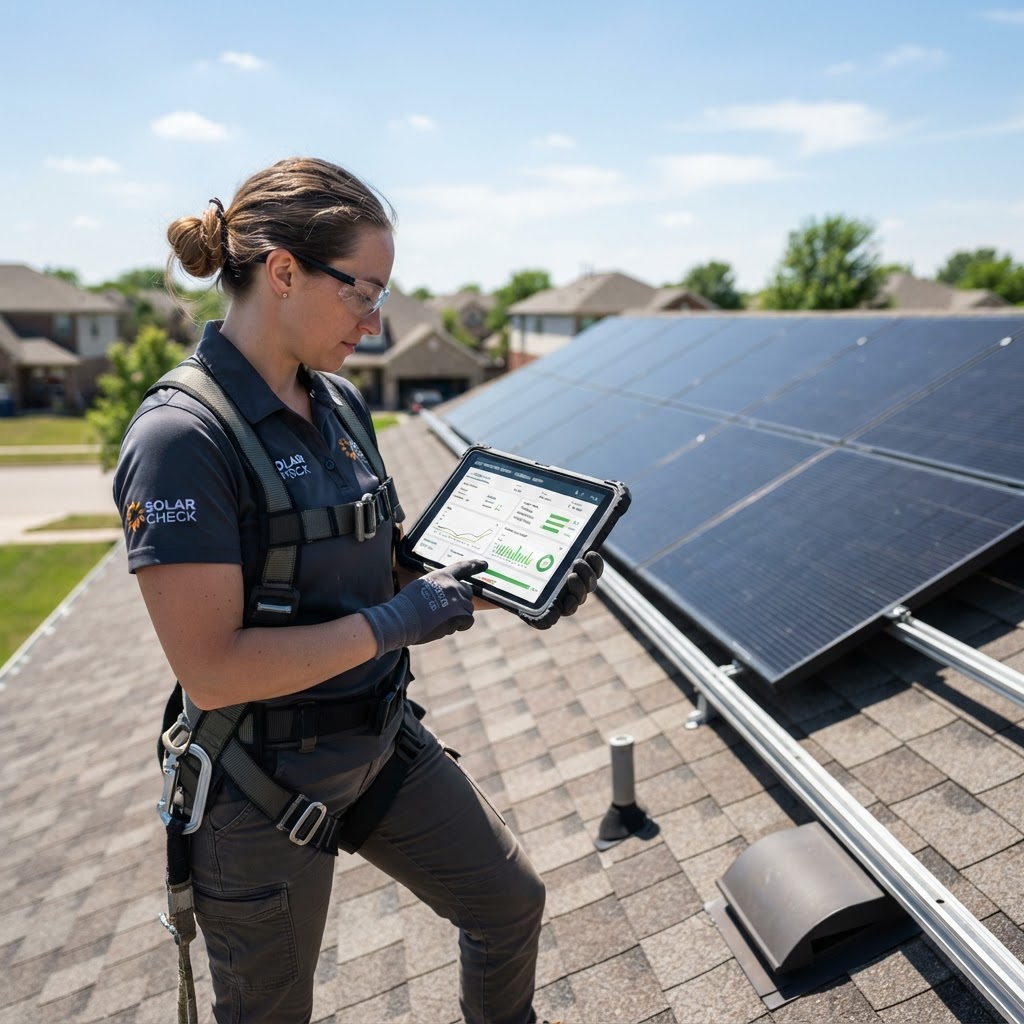
A poorly written solar panel inspection report can invalidate findings, expose you to liability, and delay insurance claims or compliance approvals. The core requirements are consistent evidence, traceable methodology, and findings tied to measurable thresholds — not vague observations. This guide covers what a defensible solar inspection report must contain, and where most inspectors go wrong.
Insurers, strata managers, and certifiers reject solar inspection reports for predictable reasons. Understanding these reasons before you write a single line saves significant rework.
Every solar inspection report should open by identifying the governing standard under which the inspection was conducted. In Australia, this is typically AS/NZS 5033:2021 (Installation and safety requirements for photovoltaic arrays) alongside AS/NZS 4777.1 for grid-connected inverters. In the US, inspectors reference NEC Article 690 and UL 1703. In the UK, MCS 012 and BS EN 62446-1 apply.
Omitting these references means a certifier cannot verify that your methodology was appropriate for the jurisdiction. It also means your findings have no measurable baseline — you're describing what you saw, not whether it meets a defined standard.
A report must state exactly what was and was not inspected. Did you assess only the array, or also the inverter, isolators, cabling, and earthing system? Did you conduct a visual inspection only, or did you include IV curve tracing or thermographic scanning?
Scope gaps are a liability issue. If a fire starts in a DC isolator you didn't document as outside scope, your report becomes a problem rather than a defence.
A well-structured report follows a logical sequence that any qualified reviewer can navigate quickly. The sections below represent accepted practice across Australian, US, and UK inspection contexts.
Include:
Irradiance matters because visual and thermal inspections conducted below 600 W/m² produce unreliable results. If conditions were marginal, state this explicitly and note any limitations it places on findings.
List the standards that governed the inspection. Then describe your methodology: visual inspection sequence, any instruments used (thermal camera model and calibration date, IV curve tracer, insulation resistance tester), and how panels were identified (manufacturer serial number, string ID, physical location code).
Include a schematic or annotated photograph showing the array layout, string configuration, and panel numbering convention. This is non-negotiable for any report involving more than a handful of panels. Without it, a defect recorded as "panel 14" is meaningless to anyone reviewing the report six months later.
Organise findings by component type, not by walking order. Grouping all glass surface defects together, all junction box issues together, and all earthing issues together makes the report easier to audit and easier to act on.
For each finding, record:
| Field | Required detail | |---|---| | Panel ID / location | String number and position, or physical label | | Defect description | Specific, measurable language | | Severity | Critical / Major / Minor per your defined criteria | | Supporting photo reference | Filename and timestamp | | Applicable standard clause | e.g. AS/NZS 5033 Clause 4.3 | | Recommended action | Repair, replace, monitor, or further test |
Thermographic inspection involves using an infrared camera to detect temperature differentials across a solar array, which can indicate cell faults, bypass diode failures, or delamination. This section requires its own data inputs to be valid:
Without this data, thermal images are photographs. With it, they are evidence.
If you conducted electrical testing, present results in tabular format against the manufacturer's specification or the standard's acceptable tolerance. For insulation resistance testing, AS/NZS 5033 requires a minimum of 1 MΩ per string. For open-circuit voltage (Voc) and short-circuit current (Isc) measurements, record actual versus expected values and the percentage deviation.
Provide an overall system condition rating — a simple scale such as Satisfactory / Requires Maintenance / Requires Immediate Action works well. List all critical and major findings in a summary table with recommended actions and suggested timeframes.
"Discolouration noted on several panels" tells no one anything useful. How many panels? Which panels? What colour, and over what proportion of the cell area? A defensible description reads: "Yellowing discolouration observed on approximately 30% of cell area, panels 7 and 12 in String 2, consistent with EVA encapsulant browning. Refer to Photo IMG_0847."
Specificity protects you. It also allows a maintenance team to find the fault without re-inspecting the entire array.
If your report classifies a finding as "critical," you need to define what critical means in your methodology section and show why the finding meets that definition. Saying a panel is critical because it "looks bad" will not survive scrutiny from an insurer or strata committee.
A workable severity framework:
Photos that are not referenced in the findings are decoration. Every finding must cite a specific photo filename and timestamp. Photos must also be taken at a resolution sufficient to show the defect clearly — a 1MP image of a micro-crack is not evidence.
Use consistent file naming: [SiteID]_[StringNo]_[PanelNo]_[DefectType]_[DateTime].jpg. This sounds pedantic until you are defending a report in a dispute.
Accessibility constraints are common on solar inspections: pitched roofs, obstructions, or safety restrictions may prevent close inspection of certain panels. Any area not fully inspected must be documented as such, with the reason stated. Silence on this point implies full coverage.
If your photos label a panel as "A-14" but your findings table calls it "String 1, Position 14" and your array map shows "Row A, Module 14," a reviewer will struggle to reconcile them. Agree on a single identification convention before you start and apply it without deviation.
All grid-connected solar installations must comply with the Clean Energy Council (CEC) guidelines and AS/NZS 5033. Reports for insurance or strata purposes will often be reviewed against these. If the installation predates the current standard, note the original standard and any grandfathering provisions.
AHJ (Authority Having Jurisdiction) requirements vary by state and county. Reports should identify the AHJ and reference the applicable NEC edition adopted in that jurisdiction. For insurance underwriting, carriers often require reports to follow InterNACHI's solar inspection SOP or an equivalent.
Installations under the MCS (Microgeneration Certification Scheme) must have commissioning documentation against MCS 012. Post-installation inspection reports should reference BS EN 62446-1:2016 for commissioned system documentation and IEC TS 62446-3 for thermographic inspection.
Manual data entry is where most errors originate. Transcribing panel IDs, weather data, and photo references by hand after a site visit introduces inconsistencies that undermine otherwise solid fieldwork.
Platforms like Inspectra AI allow inspectors to capture photos, voice notes, and field observations on-site and convert them into structured, standard-referenced reports. Auto-populated timestamps, GPS tags, and panel ID fields eliminate the most common sources of inconsistency. The inspector retains full editorial control — findings are reviewed and approved before the report is finalised — but the scaffolding is built automatically.
For solar inspectors managing multiple sites or high-volume strata portfolios, this matters. A report that takes three hours to write manually can be drafted in under thirty minutes when the structure and data linkage are handled automatically. If you want to see how that works in practice, start a free trial and run a sample report against one of your recent inspections.
Australian solar inspection reports should reference AS/NZS 5033:2021 for PV array installation and safety, AS/NZS 4777.1 for grid-connected inverters, and Clean Energy Council guidelines where applicable. If thermographic inspection was conducted, IEC TS 62446-3 provides the methodology standard for that component.
Each hotspot should be documented with the panel ID, the delta-T (temperature differential above baseline), the irradiance level at the time of scanning, and a thermal image with a colour scale bar visible. The IEC TS 62446-3 standard recommends a minimum irradiance of 600 W/m² for valid thermal scanning.
Yes. Any panel or area not inspected must be explicitly noted in the report along with the reason (e.g. safety restrictions, roof access limitations). Failing to document exclusions implies full coverage and creates significant liability exposure.
No single universal standard mandates a specific resolution, but photos must be sufficient to clearly show the defect described. As a practical minimum, 5MP is widely accepted. For micro-crack documentation, close-up electroluminescence (EL) imaging may be required, which is a separate process from standard visual inspection.
Most standards and manufacturer warranties recommend a formal inspection every two years, with annual visual checks. High-soiling environments (near coast, construction, or agriculture) may warrant annual thermal inspections. Insurance policies may specify minimum inspection frequencies as a condition of cover.
Generally no. Insurers and certifiers require findings to be traceable to specific panels or components. A report that cannot locate a defect within the array offers no actionable information and will typically be returned for revision or rejected outright.
A solar panel inspection report is only as useful as its evidence chain. Specific panel IDs, referenced standards, calibrated instrument data, and unambiguous severity classifications are what separate a report that holds up from one that gets rejected. The mistakes outlined here — vague language, missing scope statements, unsupported severity calls — are avoidable with the right process in place before you arrive on site.
If you're writing solar inspection reports manually and finding that quality control eats up as much time as the inspection itself, Inspectra AI is worth a look. The platform handles report structure, photo linkage, and standards referencing automatically, so your time goes into the inspection — not the paperwork.