
All articlesstrata inspection
Strata Inspection Costs: What to Expect and Why
Inspectra AI Team October 16, 2026 9 min read
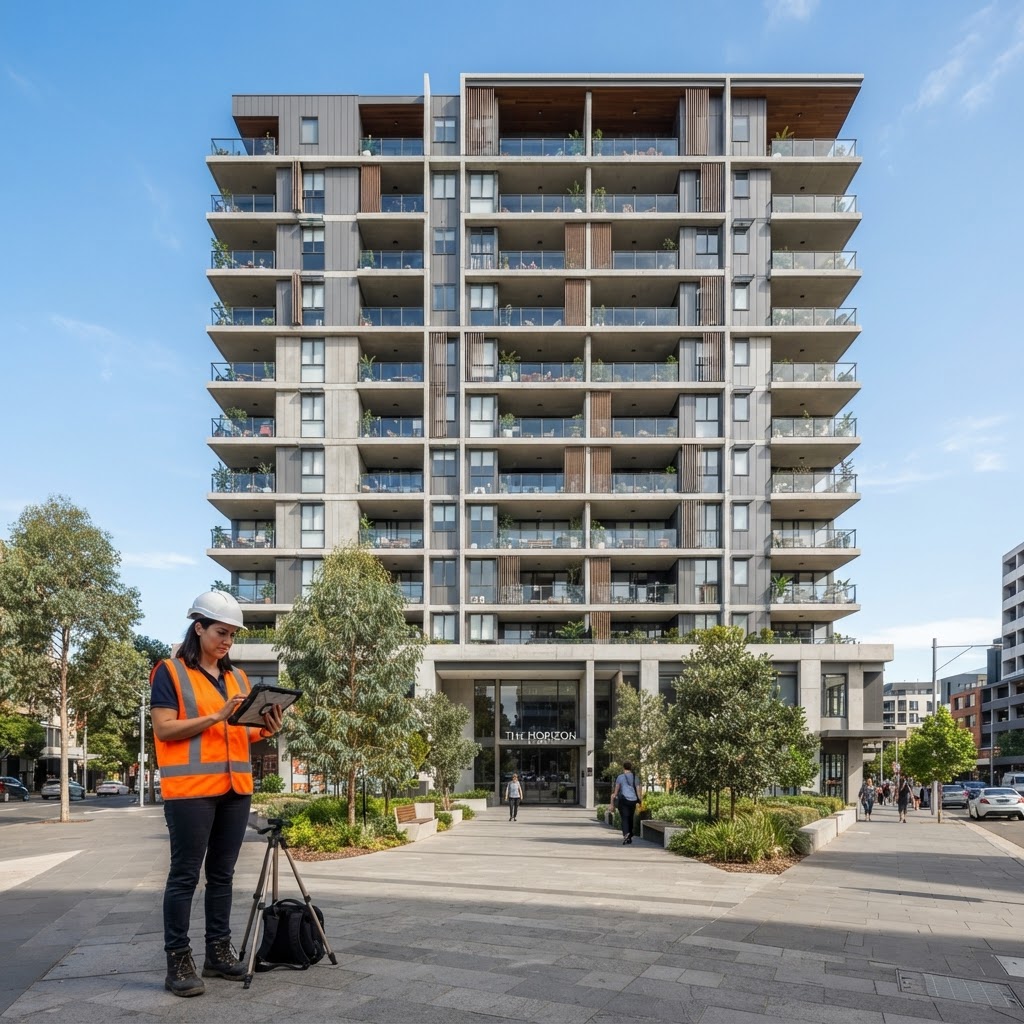
Strata inspection costs in Australia typically range from $400 to $2,500+, depending on building size, report type, and inspector credentials. In the US and UK, equivalent surveys sit in broadly similar ranges. Understanding what drives those numbers helps strata managers, lot owners, and property professionals commission the right report without overpaying — or underbuying.
Strata inspection pricing is not arbitrary. Inspectors price based on the time required to complete a thorough site assessment, the risk they carry in signing off findings, and the complexity of the structure being assessed. Below are the primary cost drivers.
The single largest variable is how much physical space must be inspected. A two-storey, six-lot block in suburban Adelaide takes an experienced inspector three to four hours on site. A 120-lot high-rise in Sydney or Melbourne may require multiple site visits, a team of inspectors, and specialist access equipment — easily pushing costs to $3,000–$6,000 for a comprehensive report.
As a rule of thumb:
| Building size | Approximate cost (AUS) | Approximate cost (UK) | Approximate cost (US) | |---|---|---|---| | Small block (2–10 lots) | $400–$800 | £350–£700 | $350–$750 | | Medium block (11–50 lots) | $800–$1,800 | £700–£1,500 | $750–$1,600 | | Large / high-rise (50+ lots) | $1,800–$5,000+ | £1,500–£4,000+ | $1,600–$4,500+ |
Figures are indicative. Always obtain itemised quotes.
Not all strata inspections are the same. The three most commonly commissioned reports carry different scopes — and different price tags.
1. Building condition report A visual, non-invasive assessment of the common property: structure, roof, façade, services, and safety installations. Governed in Australia by AS 4349.1-2007. This is the baseline strata inspection most committees commission every five to ten years, or before purchasing into a scheme. Expect $400–$1,200 for most residential strata.
2. Defect inspection report A targeted investigation of specific known or suspected defects — cracking, water ingress, spalling concrete (concrete cancer), fire compartment breaches, or façade cladding issues. May involve invasive testing, moisture meters, thermal imaging, or borescope cameras. Specialist defect reports are typically $800–$3,500 depending on scope and the number of defects being assessed.
3. Capital works fund (sinking fund) forecast A 10-year or 25-year maintenance forecast required by strata legislation in most Australian states (e.g. Schedule 2, Strata Schemes Management Act 2015 in NSW; s.100 of the Owners Corporations Act 2006 in Victoria). This report is as much a quantity surveyor exercise as an inspection, and costs $800–$2,500 for most blocks.
In Australia, strata inspectors should hold a builder's licence, engineering qualification, or building surveying accreditation. Engineers (MIEAust or CPEng) typically charge more than licensed builders, but their reports carry more weight in dispute resolution and litigation. Boutique specialist firms charge a premium; generalist property inspection businesses are cheaper but may lack strata-specific depth.
In the UK, RICS-accredited surveyors command £150–£250 per hour. In the US, InterNACHI-certified inspectors are a common benchmark, though licensing requirements vary by state.
Remote or regional buildings incur travel costs — often charged at a per-kilometre rate or as a flat regional loading of $100–$400. High-rise buildings requiring EWP (elevated work platform) or abseiling access for façade inspection add $500–$2,000+ to the base fee. Locked plant rooms, unavailable lot owner access, and poor site documentation all extend on-site time and push costs up.
Standard turnaround is five to ten business days. Urgent or expedited reports — often needed ahead of AGMs, settlement deadlines, or tribunal hearings — attract a 20–40% premium.
A well-scoped strata inspection fee should cover:
What is usually not included: invasive or destructive testing, specialist subcontractor fees (e.g. hydraulic or electrical engineers), strata records searches (a separate service in Australia), or re-inspection after remediation.
A $1,200 building condition report can identify $80,000–$300,000 worth of latent defects before they become critical failures. Common examples include:
The strata committee's duty of care — and in most jurisdictions, legal obligation — to maintain common property is well established. Regular inspections are the documented evidence that the committee is meeting that obligation.
When soliciting quotes, ask each inspector to specify:
The cheapest quote often omits roof space, subfloor, or plant rooms — areas where the most expensive defects hide.
AI-assisted inspection platforms like Inspectra AI are reducing the time inspectors spend on report writing — typically 2–4 hours per report — by converting site photos, voice notes, and field observations into structured draft reports automatically. This means inspectors can complete more reports per week without sacrificing quality, and some of those efficiency gains are being passed to clients through competitive pricing.
For strata managers commissioning multiple annual inspections across a portfolio, the reduction in per-report cost can be material. More importantly, AI-assisted reports tend to be more consistent in structure and less prone to omission errors, which matters when reports are used in dispute resolution or insurance claims.
If your inspector is still writing reports manually from handwritten notes three days after the site visit, it is worth asking whether their process is current.
Most strata legislation and industry best practice recommends a full building condition report every five years, with interim visual checks annually. Capital works fund forecasts are typically required every ten years under Australian state legislation, though NSW mandates a 10-year forecast updated every five years under the Strata Schemes Management Act 2015.
In most Australian states, the owners corporation (body corporate) is responsible for maintaining common property and therefore funds inspections through the administrative or capital works fund levy. Individual lot owners requesting a pre-purchase strata records search or independent condition assessment pay for that separately, typically $300–$900 for a strata records inspection.
Yes, provided the report is prepared by a suitably qualified inspector and meets the evidentiary standards of the relevant tribunal. In NSW, the NSW Civil and Administrative Tribunal (NCAT) regularly accepts building inspection reports as evidence in strata disputes. Reports should clearly identify the inspector's qualifications, methodology, and the standards applied. Reports prepared to AS 4349.1-2007 carry more weight than unstructured visual assessments.
A strata inspection is a physical assessment of the building and common property. A strata records search (also called a strata report or Section 184 certificate search in NSW) is a review of the owners corporation's administrative records — financials, meeting minutes, insurance, outstanding levies, and disclosed defects. Both are typically commissioned before purchasing into a strata scheme, but they are different products delivered by different professionals.
For straightforward low-rise residential strata, a licensed builder or general building inspector with strata experience is often sufficient. For complex mixed-use strata, high-rise buildings, buildings with known defect history, or situations where the report may be used in legal proceedings, an engineer or accredited building surveyor with specific strata expertise is advisable. Always verify their PI insurance is current and specific to the work being performed.
On-site time ranges from two hours for a small six-lot block to a full day or multiple visits for a large complex. Report preparation adds two to five business days in most cases, though AI-assisted platforms like Inspectra AI can reduce that to same-day or next-day turnaround for straightforward reports.
Strata inspection costs are determined by building size, report type, inspector qualifications, and access complexity. For most residential strata, budget $400–$1,800 for a condition report and $800–$2,500 for a capital works forecast. The investment is marginal against the cost of undetected defects or a failed tribunal case.
If you manage a strata portfolio and want to reduce the time and cost of turning site data into professional reports, start a free trial with Inspectra AI and see how much faster your inspection workflow can move.