
All articlesstrata inspection
Strata Inspection Reports Explained: Your Questions Answered
Inspectra AI Team September 16, 2026 9 min read
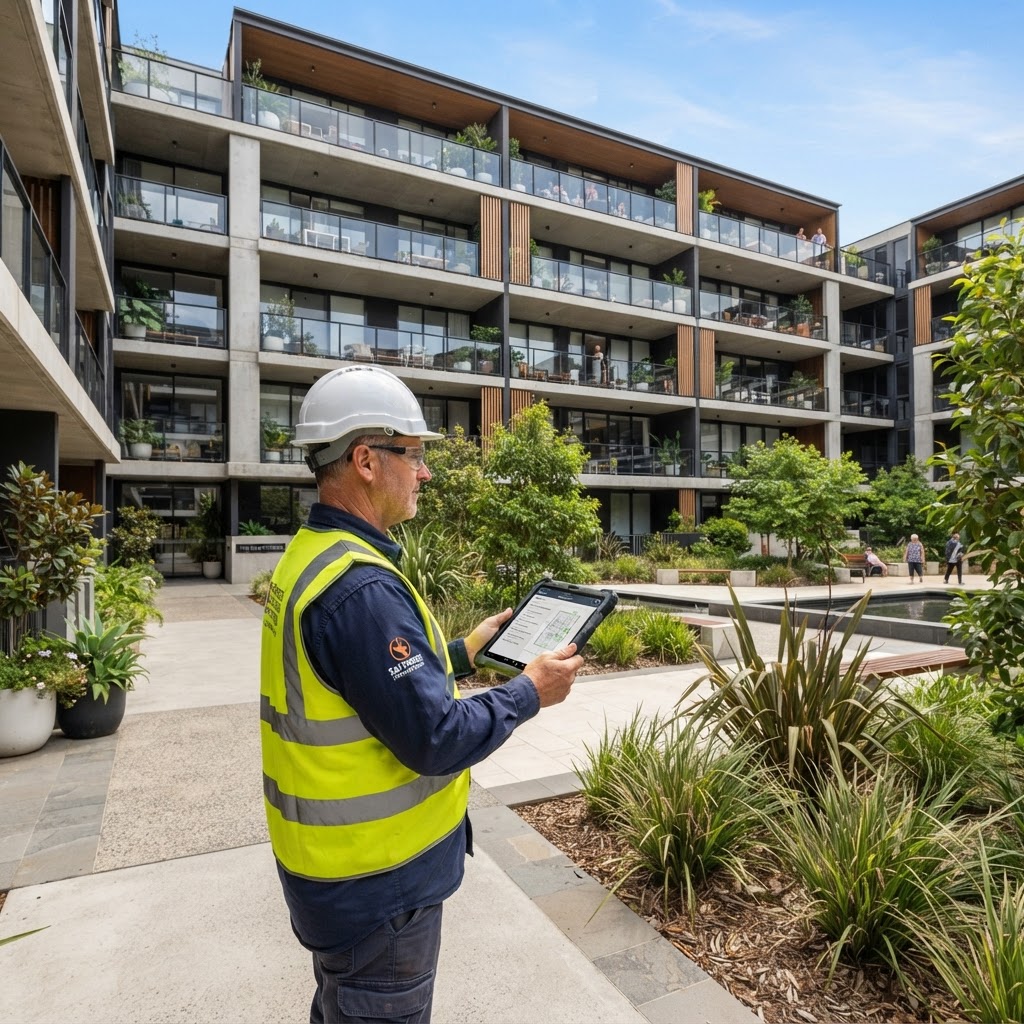
A strata inspection report is a formal document that assesses the physical condition, maintenance records, and compliance status of a strata-titled property — covering shared areas, building fabric, and owner corporation obligations. Whether you're a strata manager preparing for an AGM, an inspector conducting a defect review, or a buyer doing due diligence, understanding what these reports contain and how they work is essential. This guide answers the most common questions professionals ask about strata inspection reports.
A strata inspection report is a written assessment of a strata scheme's common property — the areas and building fabric shared by all owners. Common property typically includes external walls, roofs, lobbies, stairwells, car parks, lifts, fire safety equipment, drainage, and garden areas.
The report is distinct from a standard building inspection in two key ways:
In Australian states, the report is sometimes called a strata records inspection or Section 184 certificate (NSW) when it focuses on financial and administrative records. A physical inspection of the building itself is a separate but complementary document.
While formats vary by jurisdiction and inspector, most comprehensive strata inspection reports cover:
| Area | What inspectors check | |---|---| | Roof and guttering | Condition, ponding, flashings, penetrations | | External walls and cladding | Cracks, spalling, render failure, ACM cladding | | Waterproofing | Balconies, wet areas, basement tanking | | Fire safety systems | Extinguishers, hydrants, FIP, evacuation plans | | Common area finishes | Flooring, ceilings, paintwork, lighting | | Lifts and mechanical plant | Age, service records, visible defects | | Drainage and stormwater | Blockages, condition, compliance | | Car parks and driveways | Surface condition, line marking, lighting |
Several stakeholders commission these reports for different reasons:
Prospective buyers order them before exchanging contracts to assess deferred maintenance risk, funding adequacy, and any unresolved defects that could trigger special levies.
Strata managers arrange periodic inspections — typically every 1–3 years — to update maintenance registers, inform capital works planning, and satisfy duty-of-care obligations to owners.
Insurance adjusters use them post-event (fire, water damage, storm) to establish pre-loss condition and verify coverage adequacy.
Developers and builders commission them at practical completion and again at the end of the statutory warranty period (in NSW, this is 6 years for major defects under the Home Building Act 1989).
Legal and dispute professionals use inspection reports as evidence in owners corporation disputes, NCAT proceedings (NSW), VCAT (Victoria), or equivalent tribunals.
On-site time depends on building size and complexity:
Report turnaround is heavily influenced by workflow. Inspectors using dictation tools or AI-assisted platforms like Inspectra AI can substantially compress drafting time compared to manual report writing.
| Market | Typical fee range | |---|---| | Australia (physical inspection) | AUD $400–$1,200 | | Australia (strata records search) | AUD $250–$600 | | United Kingdom (building survey) | GBP £500–£1,500 | | United States (HOA inspection) | USD $300–$900 |
Fees vary based on lot count, building height, location, and whether specialist trades (eg. fire engineer, hydraulic consultant) are required.
There is no single universal standard, but inspectors should be familiar with the following depending on jurisdiction:
Based on industry data from Australian and UK strata schemes, the most frequently documented defects are:
Documentation quality directly affects the report's utility for owners corporations, lawyers, and insurers. Best practice includes:
Voice-to-report tools significantly reduce the risk of missed items. Field inspectors who narrate observations room-by-room and upload photos in real time produce more complete records than those relying on handwritten notes transcribed later.
A standard building inspection report typically covers a single lot or dwelling — assessing the condition of walls, roof, plumbing, and electrical within that unit. A strata inspection report focuses exclusively on common property shared by all owners in the scheme, including structural elements, shared services, and communal areas. They are complementary documents, and buyers often commission both.
In most jurisdictions, a strata inspection is not legally mandated before purchase — but it is strongly recommended. In NSW, vendors are required to provide a Section 184 certificate (a financial and administrative records extract) as part of the contract of sale, but this is not a physical inspection. Some strata schemes include periodic inspection requirements in their by-laws or management agreements.
Industry best practice — and guidance from bodies like Strata Community Association (SCA) in Australia and RICS in the UK — recommends a comprehensive physical inspection every 1–3 years for most residential strata schemes. High-rise buildings, older stock (pre-1990), and schemes with known defect histories warrant annual reviews. Insurance providers may also specify minimum inspection frequencies as a policy condition.
Yes. Strata inspection reports prepared by qualified and insured inspectors are regularly accepted as evidence in NCAT (NSW), VCAT (Victoria), and equivalent bodies. The report must clearly identify the inspector's qualifications, the inspection date and scope, and the methodology used. Reports produced by unqualified parties or those lacking site access to all common areas carry reduced evidentiary weight.
In Australia, inspectors should hold a builder's licence or be a registered building inspector under relevant state legislation (requirements vary by state). Membership of the Master Builders Association, HIA, or AIBS (Australian Institute of Building Surveyors) is a positive indicator. In the UK, look for RICS-accredited surveyors (MRICS or FRICS). In the US, InterNACHI or ASHI certification is widely recognised. Always verify professional indemnity insurance coverage before engaging.
The fastest path to a complete, professional report is combining thorough on-site documentation — systematic photos, voice notes, and measured observations — with an AI-assisted drafting platform. Tools like Inspectra AI convert field data into structured, human-reviewable reports in a fraction of the time manual methods require. The inspector still reviews, approves, and signs off the final document; the AI handles formatting, categorisation, and narrative generation.
Strata inspection reports are one of the most consequential documents in property management — they inform capital works budgets, protect owners from hidden liabilities, satisfy insurance and compliance obligations, and provide legal evidence when disputes arise. Getting the scope, methodology, and documentation right is not optional.
For inspectors looking to produce faster, more consistent, and more defensible strata reports, start a free trial with Inspectra AI and see how AI-assisted reporting changes what's possible in the field.